Latour
a featured wine
Our Latour wines |
Parker Score hover or click for more |
|||||
|---|---|---|---|---|---|---|
| Wine | Vintage | Case size | Price/case | Cases | ||
| Forts de Latour | 2008 | 12×75cl | £1,500 | 2 | 91 | ![]() ![]() |
| A strong effort, this 2008 exhibits a dark ruby/purple color, more minerality than the 2010 and hints of cedarwood, black currants, underbrush and forest floor. This round, generous blend of 66.5% Cabernet Sauvignon and 33.5% Merlot should easily last for two decades or more. | ||||||
| Forts de Latour | 2009 | 12×75cl | £1,750 | 3 | 95 | ![]() ![]() |
| Very deep purple-black in color, this wine has aromas of creme de cassis, cinnamon toast, dark chocolate and vanilla pod. Medium to full bodied, rich and expressively fruity already, it has a medium to firm level of velvety tannins and a long finish. | ||||||
| Latour | 1996 | 12×75cl | £6,000 | 2 | 99 | ![]() ![]() |
| A spectacular Latour, the 1996 may be the modern day clone of the 1966, only riper. This vintage, which is so variable in Pomerol, St.-Emilion, and Graves, was fabulous for the late-harvested Cabernet Sauvignon of the northern Medoc because of splendid weather in late September and early October. An opaque purple color is followed by phenomenally sweet, pure aromas of cassis infused with subtle minerals. This massive offering possesses unreal levels of extract, full body, intensely ripe, but abundant tannin, and a finish that lasts for nearly a minute. Classic and dense, it displays the potential for 50-75 years of longevity. Although still an infant, it would be educational to taste a bottle. Anticipated maturity: 2015-2050. | ||||||
| Latour | 2002 | 12×75cl | £3,950 | 1 | 96 | ![]() ![]() |
| The wine of the vintage? There are only 10,000 cases of this extraordinarily rich, dense 2002 that is as powerful as the 2003 (even the alcohol levels are nearly the same, 12.85%) . It is dark ruby/purple to the rim, with notes of English walnuts, crushed rocks, black currants, and forest floor, dense, full-bodied, and opulent, yet classic with spectacular aromatics, marvelous purity, and a full-bodied finish that lasts just over 50+ seconds. Huge richness and the sweetness of the tannin are somewhat deceptive as this wine seems set for a long life. Administrator Frederic Engerer seems to be more pleased with what Latour achieved in 2002 than in any other recent vintage. Hats off to him for an extraordinary accomplishment in a vintage that wouldn’t have been expected to produce the raw materials to achieve something at this level of quality. Anticipated maturity: 2012-2045. | ||||||
| Latour | 2007 | 12×75cl | £3,800 | 1 | 92 | ![]() ![]() |
| The 2007 Latour (the first wine made in the newly renovated cellars) exhibits a dense ruby/purple color as well as a sweet, expansive bouquet of black fruits and spring flowers interwoven with a striking minerality. The wine’s dense, medium to full-bodied flavors are surprisingly evolved, with soft tannins, an ample, generous mouthfeel, and an endearing texture. Undoubtedly one of the longest lived wines of the vintage, the 2007 Latour should last for two decades or more. | ||||||
| Latour | 2008 | 12×75cl | £4,600 | 1 | 95 | ![]() ![]() |
| An extraordinary wine, the classic 2008 Latour (13.5% natural alcohol) is composed of 94% Cabernet Sauvignon, 5% Merlot and 1% Cabernet Franc (40% of the production made it into the grand vin). Its dense purple color is followed by hints of espresso roast, cassis, burning embers, truffles and graphite. Rich with full-bodied power, beautiful purity and graciousness allied to a voluminous, savory, broad mouthfeel, this beauty will be drinkable in 4-5 years and will keep for three decades. | ||||||
| Latour | 2010 | 6×75cl | £5,750 | 3 | 100 | ![]() ![]() |
| One of the perfect wines of the vintage, Frederic Engerer challenged me when I tasted the 2010 Latour at the estate, asking, “If you rate the 2009 one hundred, then how can this not be higher?” Well, the scoring system stops at 100, (and has for 34 years,) and will continue for as long as I continue to write about wine. Nevertheless, this blend of 90.5% Cabernet Sauvignon, 9.5% Merlot, and .5% Petit Verdot hit 14.4% natural alcohol and represents a tiny 36% of their entire production. The pH is about 3.6, which is normal compared to the 3.8 pH of the 2009, that wine being slightly lower in alcohol, hence the combination that makes it more flamboyant and accessible. The 2010 is a liquid skyscraper in the mouth, building layers upon layers of extravagant, if not over-the-top richness with its hints of subtle charcoal, truffle, blackberry, cassis, espresso and notes of toast and graphite. Full-bodied, with wonderfully sweet tannin, it is a mind-boggling, prodigious achievement that should hit its prime in about 15 years, and last for 50 to 100. There is no denying the outrage and recriminations over the decision by the Pinault family and their administrator, Frederic Engerer, to pull Latour off the futures market next year. However, you can still buy these 2010s, although the first two wines are not likely to be released until they have more maturity, which makes sense from my perspective. Perhaps Latour may have offended a few loyal customers who were buying wines as futures, but they are trying to curtail all the interim speculation that occurs with great vintages of their wines (although only God knows what a great vintage of future Latour will bring at seven or eight years after the harvest). As a set of wines, the 2010s may be the Pinaults’ and Engerer’s greatest achievements to date. Of course, I suspect the other first-growth families won’t want to hear that, nor will most of the negociants in Bordeaux, but it’s just the way things are. Frederic Engerer, by no means the most modest of administrators at the first growths, thinks it would be virtually impossible to produce a wine better than this, and he may well be correct. If they gave out Academy Awards for great performances in wine, the Pinaults and Engerer would certainly fetch a few in 2010. P.S. Just so you don’t worry, Engerer offered up the 2009 next to the 2010 to see if I thought it was still a 100-point wine, and yes, ladies and gentlemen, it still is. | ||||||
|
Don’t see the Latour you are looking for? Get in touch – we will track it down for you if at all possible |
||||||
Château Latour
Vineyards are documented at Chateau Latour as far back as the 14th century (the estate disposes of more farther-dating archives than any other chateau), with those vineyards that were to underpin its now worldwide reputation established by the 17th century, following the consolidation under single ownership (the de Mullet family) of a number of smaller holdings. Soon after, in the 18th century, Latour was among the first New French Clarets to appear in the emergent London Coffee House scene.
Located at the southern edge of Pauillac on the border with St. Julien, the vineyards almost abut those of leading super second Ch. Léoville Las Cases.
Like all First Growths, Latour has undergone a series of ownerships and, equally like all First Growths, has largely stayed in French hands. After a period with the Pearson Group, an English family company it was sold to Allied Lyons. In 1993 Chateau Latour was bought by its present owner François Pinault, a French billionaire industrialist who was to build his holdings to include Yves St. Laurent, Gucci, Christie’s Auction House and the recent purchase of leading Rhone estate, Chateau Grillet.
With a new owner came a major program of investment. However, as is so often the case with First Growths, it was perhaps the wider-management decisions that had most impacted on quality. Pinault decided to delegate day-to-day direction of the estate to its Président, Frédéric Engerer, a dynamic figure under whose stewardship Latour has raised to its position of pre-eminence in the Bordeaux Place.
Latour is a powerful, structured wine, nuanced with the classic claret notes of cedarwood and Cohiba of Pauillac. Considered perhaps the most consistent of all First Growth wines, Latour is also known for its ability to produce good wines in the more challenging vintages. The Grand Vin is among the most long-lived wine of all Bordeaux chateaux, with the best vintages lasting up to 100 years or more. Les Forts de Latour, one of the best known second wines in the Medoc, is based on a separate vineyard from the Grand Enclos (that of Latour) and thus has its own distinct identity.
| Vintage
| RP
| JR
| Market price £
| £/Parker Points
|
| 2009
| 98-100
| 19
| 12700
| 128
|
| 2008
| 96-98
| | 8050
| 83
|
| 2006
| 95
| 18
| 5250
| 55
|
| 2005
| 96
| 18+
| 9500
| 99
|
| 2004
| 95
| 15.5
| 4500
| 47
|
| 2003
| 100
| 18++
| 9950
| 100
|
| 2002
| 96
| 16.5
| 4800
| 50
|
| 2001
| 95
| 17.5
| 4650
| 49
|
| 2000
| 98
| 18.5
| 11888
| 121
|
| 1996
| 99
| 17
| 7895
| 80
|
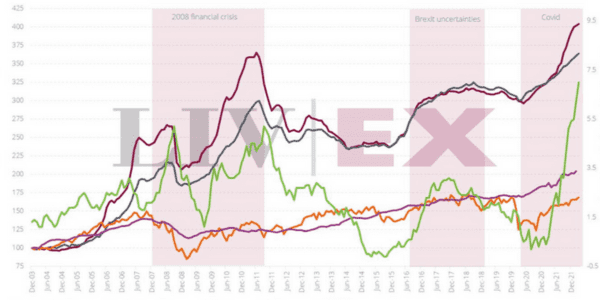
Latour is currently enjoying a period of sustained momentum as it and other First Growths and equivalent wines become better value, as they start to move towards the new price ceiling established by Lafite.
In 2010, Latour ranked 2nd in the Liv-ex Power 100 ranking, up from 5th spot last in 2009. The Liv-ex Power 100 is a list of the top performers over the previous year and their position starting the current year. The indice traces the movement of chateau and other wines using a sophisticated weighting system based on average prices, production, notional availability and Parker Points.
| Release price evolution
| ||
| Vintage
| Ex-négociant €
| London release price £
|
| 2009
| 7,200
| 10,500
|
| 2008
| 1,560
| 1,590
|
| 2007
| 2,880
| 2,495
|
| 2006
| 3,900
| 3,250
|
| 2005
| 4,920
| 4,500
|
Commune: Pauillac
Soils: Deep, gravel-rich plateau with important iron and marl deposits
Climate: Maritime
District: Medoc
Classification: 1er Cru Classe 1855
Owner: François Pinault
Wine-maker: Frédéric Engerer
Vineyard: 77 ha/190 acres (11 ha were acquired in 2005)
75% Cabernet Sauvignon vines, 24 % Merlot (increased from 15 per cent in the 1980s), very small amounts of Cabernet Franc and Petite VerdotVinfication and ageing (Grand Vin): vats by parcel, 3-week maceration, aged in new oak casks
Production avg: 30,000 cases
Wines: Latour (16-20,000); Les Forts de Latour (since 1966, 10-12,000 cases); Pauillac
Other properties: Chateau Grillet, Rhone Valley


English
中文 (葡萄酒和博客用英語)
日本語 (ワイン在庫表&ブログ)