Petrus
a featured wine
Our Petrus wines |
Parker Score hover or click for more |
|||||
|---|---|---|---|---|---|---|
| Wine | Vintage | Case size | Price/case | Cases | ||
|
We have no Petrus at the moment. However if you are looking for a particular wine then get in touch – we will track it down for you if at all possible |
||||||
Château Petrus
It has been said that Pomerol is the wine that makes you like wine. Its rich generosity has immediate appeal, yet its grace – like all fine wines – is in the unique subtleties that reveal themselves over time. The combination of clay with Merlot in the revered vineyards of Petrus is complete, yielding a wine whose exotic flavours display a restrained quality at once powerful but refined.
The most expensive of Bordeaux wines, Petrus has a humble and far more recent beginning compared to that of its Medoc peers. The chateaux first appears in the early 18th century, but wines from Pomerol were held in low regards for much of the time up until 19th century.
Research shows the oldest records regarding the history of Petrus goes back to the early 18th century. This is in reference to a transaction with Jacques Meyraud who bought some vineyards located at Gazin from the Voisin family. This is interesting because a few hundred years later Gazin once again sold some of their best land to Petrus. At this time there are references to Gazin being called Petrus at the time.
The son of the Voisin family, Pierre sold Petrus to M. Brilhouet and Courolle. They were local butchers from the village of Libourne. The land was later sold to M. Antoine Arnaud in 1770. For more than a century, the Arnaud family maintained ownership of the property. At that time, the small chateau was widely known as Arnaud-Petrus. Quite where the name Petrus came from is unclear, although the label on bottles of Petrus reflects its Latin rendering of Peter, showing St. Peter holding the keys to the gate.
In 1917, M. Sabin-Douarre, formerly the estate’s manager, purchased the Pomerol property and established the Société Civile du Château Pétrus. Sabin-Douarre married Madame Loubat, who owned Sabin-Douarre’s favoured restaurant, Libourne's best, l’Hotel Loubat. In 1923, Madame Loubat became his partner, then, after World War 2, she purchased the remaining shares from him to become the sole owner.

The Loubat family knew the Bordeaux wine trade well, they owned two small properties in Pomerol, Jeanlade and Chante-Caille, while their brother was the Mayor of Libourne. It was at this point that the fate of Chateau Petrus was to take the turn for which it is most known.
Upon completion of the purchase, Madame Loubat assigned through contract Jean-Pierre Moueix the distribution of her wine and two worked together to make Petrus what it is today. Each believed Petrus grew the finest Bordeaux wine produced and began to charge prices to reflect this. Madame Loubat’s passed away in 1961, leaving no children, thus inheritance passed to her nephew and niece. A share of Petrus was, however, bequeathed to Jean Pierre Moueix, ensuring his continuation in the running of the estate.
Following this, the Moueix family proceeded to purchase the remainder of the estate from the Lacostes in stages, first by Jean-Pierre Moueix in 1964, then by his oldest son Jean-Pierre in 1969. In this year Jean-Pierre bought 12.5 acres of prime vineyard from Gazin, substantial expanding those available to Petrus. Jean-Pierre Moueix passed away in 2003, leaving his eldest son, Jean-François, to take charge of Pétrus, while the younger son, Christian Moueix, managed production.
When Jean-Pierre Moueix began, he realised that negociants had no real interest in the wines of Pomerol, so he opened his own negociant firm. Thus establishing through need the largest and most significant negociant house in Pomerol.
Vineyard and winemaking
Petrus began with 7 hectares at the time of the Arnaud family in the 18th century. Today, Petrus farms 11.5 hectares located at the top of the hill of Pomerol, at 40 meters above sea leve, providing for natural water drainage. Moreover, the soil composition here is distinct to the rest of Pomerol. A rich seam of clay some 40 million years old, comparing to the thick gravel on the surrounding plateau of only 1 million years old. This in reality is composed of two distinct layers, 60-80 cm of dark clay over dense blue clay impenetrable by the vines roots, expanding with water intake to become impermeable, as such excess water will drain away but providing for a good water source during the summer helping in times hydric stress (as with 2003 and 2009).
The vineyard is planted to 11 hectares Merlot and ½ hectare of Cabernet Franc. This latter variety has, since 1982, entered the Petrus blend on average once every three years. Petrus maintains a high average vine age of 40 years, moreover the estate producing its own clones (since 1985) in order to preserve vegetal variety when replanting.
50% French new oak barrels, softened through filling with water upon arrival prior to their use. There is no second wine at Pétrus and any lots that do not enter its wine are sold off as generic Pomerol.
Style
The very word Pétrus creates a “frisson” unlike any other wine name – and the liquid in the glass induces a dream-like silence as its enormous, almost roasted flavour envelops the palate. The sheer exoticism of this revered vineyard, where clay combines with Merlot to make something wildly heady, needs to be experienced by everyone once in their life (preferably many more times!). Pétrus does not taste like other Bordeaux – it is not “classic” but stupendously original, full of oriental spice box flavours which unfold endlessly. A one-off wine that inhabits a world of its own and, of course, a rarity due to its small (11.4 hectares) size.
Petrus is a style that is unique not only to Bordeaux but within the world of wine. It displays complex aromas of wood spice, cacao and coffee interplaying with plum and floral notes, in a generous, fleshy but tightly-woven and finely-crafted robe. Produced almost and in some years we suspect, entirely from Merlot, Petrus is one of Bordeaux’s longest-lived wines lasting some 20 – 30 years.

Top-rated vintages
| Vintage | RP | JR | Market price £ | £ / Parker points |
|---|---|---|---|---|
| 2010 | 100 | 19 | 28,000 | 280 |
| 2009 | 100 | 19 | 20,000 | 200 |
| 1990 | 100 | 18.5 | 32,000 | 320 |
| 1989 | 100 | 18.5 | 30,000 | 300 |
| 1961 | 100 | 17.5 | ||
| 1947 | 100 | |||
| 1929 | 100 | |||
| 1921 | 100 | |||
| 1970 | 99 | |||
| 1967 | 99 | |||
As per January 2012
Liv-ex Power 100 ranking
| 2011 | total score | 2010 | move |
|---|---|---|---|
| 6 | 125 | 7 | +1 |
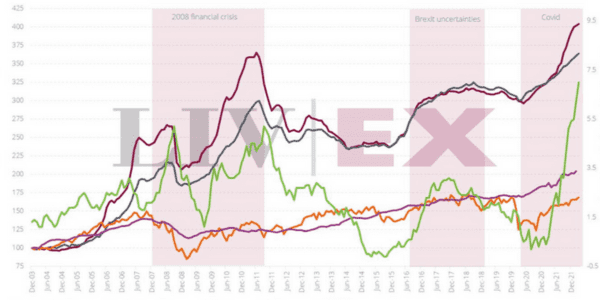
The Liv-ex Power 100 is a list of the top performers over the previous year and their position starting the current year. The indice traces the movement of chateau and other wines using a sophisticated weighting system based on average prices, production, notional availability and Parker Points.
Petrus at a glance
Commune: Pomerol
Soils: Finest vineyards are planted on a black clay seam. A complexity of molassic, sandy and clayey deposits, almost completely covered by a layer of alluvial gravel. More or less compact sandy gravel on the surface lying over a subsoil with ferrous oxide linked to a microclimate which is at least specific, not to say unique.
Climate: maritime
District: Libourne
Classification: at present there is no official classification of Pomerol, nor do producers seem to want one, although there is an unwritten ranking with Ch. Petrus at the top. Chateaux can practice healthy rivalry, which, with their commitment to quality, is likely beneficial to the renown of Pomerol.
Owner / Winemaker: Jean-François and Christain Moueix
Vinification and ageing: Merlot 95%, Cabernet Franc 5%
Production: 2,500 cases


English
中文 (葡萄酒和博客用英語)
日本語 (ワイン在庫表&ブログ)