tel: +44 (0)20 8339 9112
Ditton Wine Traders (DWT)
DWT - making fine wine accessible
 

August 2009

27 August 2009How to sell your wine?

If you are a non-merchant stock holder of wine, it’s not so straightforward to sell your wine. Presuming you have bought wine that is of interest to investors/the trade, how do you go about selling it? A lot of people I talk to don’t really know and feel highly uncomfortable about it.

The good news is there are far more options than a few years ago, thus improving competition and therefore your achievable price . There are a number of auction houses (Christies, Sotheby’s, Bonhams to name a few) and there are also wine merchants that offer live, online buying prices (Bordeaux Index and, in a few months time, Berry Brothers & Rudd amongst others) to private customers.

The bad news is that you are still likely to relinquish a high percentage of the value of the wine to whomever you sell it to.

Traditionally, private stock holders of wine wanting to sell turn to the auctions houses as their first point of call. That will immediately cost you on average 15% ex VAT of the market value of the wine. Also, the time between consigning the wine and receiving the funds in your bank account will be around 3 months minimum. The upside is that auction houses do get large numbers of interested buyers so, provided you have something to sell that buyers are willing to enter into a bidding war for, chances are you will achieve a fair "hammer price". On the whole though, this alternative will not maximize your return.

A better "route to market" for private owners of fine wine is to approach wine merchants. Often, the company that sold you the wine in the first place is the first to be contacted when you want to sell. Especially when this company is holding your wine in their own warehouse or in your "private reserve account" in a commercial bonded warehouse. Indeed, this wine merchant might contact you to ask whether you want to sell. This is an attractive way to offload excess stock, as you’re dealing with a trusted business partner and you avoid the downsides of the auction houses. 

This is also a very interesting business model for wine merchants. Imagine you’re a wine trader and you have sold wine to your customers for some years. Each sale you will have recorded in your database, showing what you sold, to whom at which price. After a few years, you’ll have potential access to a significant amount of wine. Wine that you might be able to buy back or broke on behalf of your customer. Brilliant, as it gives the merchant access to stock to sell – ensuring supply – and they can make a profit on the same case twice!

I think this is the best way to buy and sell your wine, both for merchants and individuals. For the merchant, it’s nice and easy as the "provenance" of the wine is cristal clear and there is a relationship of some sorts with the seller. For individuals (presuming you want to sell and not drink), it’s very comforting to deal with the same merchant you bought from. Hopefully, your wine will have increased in price and you can sell, not having to worry about credentials of your buyer and whether or not you will get your money.

I do think this is the most efficient and pleasant way for the "market" to work. But, there’s a big catch. Private sellers do run the risk of being ripped off. There’s always the temptation for a wine merchant to offer low prices, hoping you’re not aware of the market value or hoping you don’t have alternative buyers at hand. It’s a free market and nothing ventured, nothing gained, right?

Wrong. The only proper way to be successful in business – I passionate believe – is to treat your customers well. Always. Even is there’s a quick buck to be made. Especially when there’s a quick buck to be made. Sure, wine merchants are in it to make a profit, but at the same time, they have to give their customers the best deal possible.

And that’s exactly what Ditton Wine Traders are about. We sell at the lowest possible prices and we buy at the highest possible prices. Yes, that does decrease our margins, but more importantly, it increases the number of people we deal with and thefore, it generates sustainable turnover and profit.

The average wine merchant works on a 12%-18% margin, depending on the "tradability" of the wine. This is a figure dictated by the costs of running the business on the one hand and turnover on the other hand. Fancy offices, marketing expenditures and lots of staff might result in higher turnover, but it also necessitates a higher gross margin – i.e. the difference between the price you receive for your wine and what the merchant sells it for.

We work on 6% – 9%.


12 August 2009An update on the Fine Wine market

It’s been a while since I last wrote, for which I’d like to apologize. The idea of the blog is to keep you updated, regularly, as and when there’s news to tell. And there always is, although to be fair, after the end of the En Primeur campaign at the beginning of May, there haven’t been earth shattering events.

Having said that, there have been some noteworthy developments. In an attempt to catch up, let me take you through the last 3 months by highlighting the - in my opinion - most significant things to know if you want to stay informed about the Fine Wine market. In the future, expect to see regular updates once again.

The En Primeur Campaign. Has been far more successful than expected. The Bordeaux Negociants did fairly well and managed to get decent sales. Moreover, the risk of not being able to participate in the 2008 vintage at all – because of overstocking on 2006 and 2007 – has proved to be diluted. At the top end , the campaign was highly successful, with good margins to be made. Robert Parker’s scores obviously helped interest. Overall, the picture is a bit more difuse, the lesser names not doing that great but still managing fairly well in the extremely difficult trading conditions. The secondary trade, i.e. the merchants buying from Bordeaux, seem to have done well. Finally, the 2008 wines have, rather unexpectedly, become very interesting, both from a drinkers and investors perspective and have a future ahead of them.

The health of the wine trade. An interesting point. Post September 2008, it was on the cards that some Bordeaux based Negociants would crumble under the burden of high levels of unsold stock, jeopardizing their future. The general consensus was that we would see some Negociants go under. To this point in time, fortunately, that has not happened - the reasons for which are partly covered later on in this post. Turning to the UK wine trade, again, much better than feared. Those merchants who have filed their latest accounts (not including the ‘08 campaign) haven’t shown bumper years, but is hasn’t been carnage either. Not at all. Turnover is reasonably steady but, with margins decreasing, net profits are generally down on last year. Overall, the risk of buying En Primeur from merchants that subsequently go bust has decreased substantially. Looking at our own accounts up to July this year, we are up on last year by 80% in turnover and a very healthy 400% in net profit. Excuse me for pointing it out, but that’s a performance we’re very proud of.

The wine buyers. Have sat on their hands between September last year and January this year. Too much uncertainty and a prevailing "why buy today when tomorrow’s prices are likely to be lower?" attitude. That changed in February. Since then, although modest and not recuperating all of last year’s losses, prices have stabilized and indeed gone back up. Demand is very much driven by Asia, particularly for Lafite. This is a major factor. The US stopped buying, but Asia has more than compensated for it. Apart from that influence, we have seen very strong interest from the wine investment side, both corporate and private. Driven by low returns in the traditional markets on the one hand, growing maturity and most of all transparancy in the wine investment markets on the other hand, a lot of private individuals have turned to diverting their money to wine. Wine being a wasting asset on the supply side and growing, worldwide appetite on the demand side, there are very compelling reasons indeed to invest in wine.

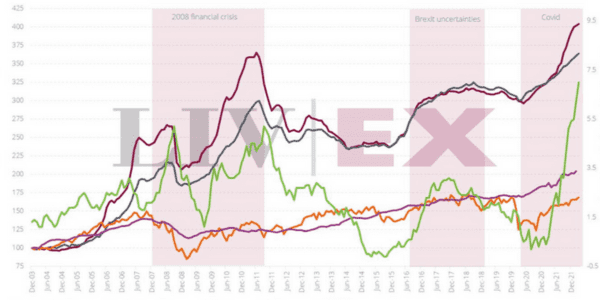
Overall performance. Allow me to use below graph from Liv-ex, which neatly captures price development:

As of the start of this year, blue chip wine has seen a price increase of 5.2% across the board. Still a long way - about 15% - off the old time high of Summer 2008 but reflecting the returned stability and growing sense of wine becoming a mainstream, alternative investment. When you’d zoom in, looking at particular Chateaux and/or vintages, you’ll see an even more telling picture. I intend to cover some of that in an upcoming blogpost.

Wine as an investment. Judging by the number of requests we get from private individuals, this must be the most interesting development of the last few months. Much more so than before, the idea of investing money in wine has caught the imagination. Every week, we get a fair number of enquiries from people that are relatively new to the idea of investing in wine, but do like the proposition. These people are generally wary of the Wine Investment Funds. They don’t like the lack of transparancy on buying and selling on the one hand, and are reluctant to pay hefty management fees on the other hand. Some bad press about scams, or funds not being able to service requests for withdrawals doesn’t help either. I always say that 1) make sure the spread between buying and selling is as low as possible as well as transparant and 2) if at all possible, make sure you have full control over the stock you have bought. I personally believe there’s no added value to investment funds - be it in wine or something else - that make their money from management fees or worse, commissions. I do however believe in honest, straightforward and transparant deals. Transactions where the supplier makes a margin on buying and selling in return for his advice and network, and the investor gets the best possible starting position, i.e. not paying more than necessary as well as buying the right stock. I will devote some more space on this topic later on, as it seems to be on a lot of people’s minds.

I do hope this little update has been of interest. Please do let me know if you’d like to know more about a specific issue or have any other requests. I’d be very happy to help.


Problems with the site? Please let us know

© Ditton Wine Traders 2008-2012

site developed by Mark Iliff, Talespinner