Ditton Wine Traders’ fine wine blog
September 2009
08/09 Investing in wine – A no brainer? • 04/09 Lafite again, is it ever going to end?
8 September 2009Investing in wine – A no brainer?
It seems the majority of fine wine buyers are currently in it to make money. With savings accounts generating next to nothing and stock markets still a bit uncertain, more and more people are turning to wine to generate a return on investment. Moreover, investing in wine somehow seems to have evolved from something reserved for the old boys network who are in the know, to savvy investors who take advantage of increased accessibility and transparancy.
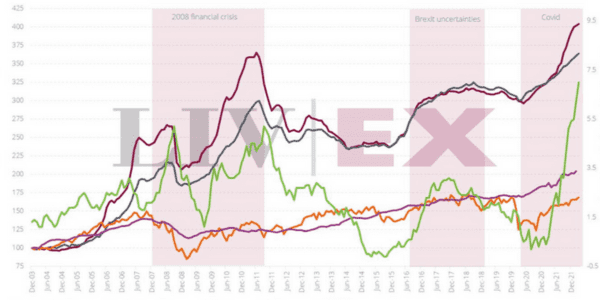
Fine Wine, as measured by the widely quoted Liv-ex 100, is now up 10% for the year and climbed an impressive 4.6% in August (normally a quiet month due to holidays). Yes, this is after a big fall last year – the Liv-ex 100 still being down 14.2% year-on-year. But this only seems to add to the attraction.
I often wonder about the Fine Wine Market. It's such a niche market and the end-users are such an elite group. And yet is has a very loyal and growing number of afficionados. Wine lovers (the type that buy to drink) hate the continual price increase, but private and corporate investors (who are in it to make money) love it.
To be fair, one can't blame investors to be attracted. Fine Wine historically has done well, outperforming stock markets. And it has a driving force that few, if any other investments have: ever diminishing supply. As long as demand is there, it's a sure bet: the wine gets consumed, it grows older, it get's better and more scarce, prices go up and there you go – a no-brainer.
A no-brainer indeed. As long as you can withstand severe price changes as we have seen in the second half of last year, where the top wines lost up to 30-35% of their value. Still better than the stock markets though... With wine, as soon as stocks had been offloaded, as soon as there was a sense of prices bottoming out, demand was back. After the evasive mood of "would you buy today, when there's a good chance that this particular wine would be cheaper tomorrow?" had passed, the fine wine market was a buyers market again.
This seems slightly odd. After all, in times of recesssion, luxury goods suffer. They always have. And they have in this recession as well. Bottled water manufacturers are suffering. Champagne sales are down more than 40% on last year. The average price of a bottle of wine as bought in the supermarkets is down. Most descretionary items – new cars, fridges, home extensions, luxury holidays etcetera- they are all experiencing difficulties.
Not Fine Wine though. Probably because it's not a "consumable" anymore. Demand is no longer aligned with the "real" economy, it's aligned with the investment markets. While demand for fridges et al. moves in sync with (un)employment, fine wine seems to move in sync with cash finding a save and profitable haven. With of course – as often commented on – the anomaly of Chinese demand for especially Lafite. Fine Wine seems to have moved on into the realms of luxury items. Status is more important than the actual pleasure of drinking (alas). And believe it or not, there is an ever growing amount of people willing to pay GBP 8,000 or more for a case of wine.
Where does it go from here? Unless Fine Wine suddenly would not be "en vogue" anymore, I can't see anything else but onwards and upwards. Not all wine will see hefty price increases, but the fundamentals are as sound as ever, is my firm belief.
4 September 2009Lafite again, is it ever going to end?
I have commented on prices of Lafite many times in this blog. More than any other wine, it catches the imagination at the moment. It might become slightly boring, but the story hasn't ended yet.
Take a look at below graph, courtesy Liv-ex:
It shows the price development of Lafite – vintages 2000-2006. Of all the investment wines, Lafite is the the only one that has managed to achieve a higher price now than at the previous high of July 2008. To illustrate this point, have a look at below graph, which depicts the average price development of the 100 best traded Bordeaux wines:
As you can see, the average price of top Bordeaux is still significantly below its previous peak. Where July 2008 showed an index of 263, it's now at 225 – after having dropped to 205. Moreover, the increase in the wider index is largely due to Lafite. It makes one wonder, is the Lafite saga ever going to end?
Kevin Hassett has written an article on Bloomberg.com, where he states there are good reasons indeed for the Lafite bubble to burst. His argument hinges on the assumption that, at some point, investors/consumers won't support the price difference between Lafite and equally (Parker) scoring wines.
Interesting. Very interesting. For him to be right, some fundamental changes in perception need to happen.
The Chinese are and will be very "status" orientated. This won't change and Lafite is the current status symbol. Some other wine needs to take its place. The most likely way for some other wine to take Lafite's place is through a combination of a change in perceived quality and kudos. In order for that to happen, Chinese consumers need to get more educated in the quality of wine. Either by adhering more relevance to Parker and/or by adopting their own, local and widely followed "wine advocate". If they do, I should think we will see a rebalancing of prices.
So, what is the likelihood of above happening? Over time, I think it's likely. In the end, price/quality will always prevail and it's out of sync at the moment. Also, hypes have – by nature – a tendency to end. In the short run though, I don't think this will happen. It will take time to 1) educate the Chinese wine lover and 2) for public, status-orientated opinion, to catch up with this new found knowledge.
Suppose we get to this point though. Suppose Lafite is no longer the talk of the town. What will the effect on prices be? Will Lafite plummet? Will a new star emerge and leave all other Chateaux behind? Or will other high scoring wines with a reputation similar to Lafite merely catch up in price while Lafite stays where it is?
That's where the law of supply and demand comes in. If Asia, and China in particular keep being being passionate about wine, supply of top rated Bordeaux will always be lower than demand. Lafite produces about 20,000 cases a year of their Grand Vin and is one of the larger Chateaux. Lafite is already so hard to find that prices are out of control. If other wines will become more en vogue, they will likely follow the same price path as their illustrious predecessor. Simply because supply won't be able to keep up with demand from such a massive population that are so into their wines.
The only thing to stop prices going up is when Asia stops buying.


English
中文 (葡萄酒和博客用英語)
日本語 (ワイン在庫表&ブログ)