tel: +44 (0)20 8339 9112
Ditton Wine Traders (DWT)
DWT - making fine wine accessible
 

January 2011

31 January 2011Should you sell your fine wine at auction?

A series of successful high-profile auctions have taken place in Hong Kong, of which three within the first month of the year. Further proof of HK’s prominent position in the Bordeaux-dominated fine and rare wines market. Two of these auctions were particularly high profile with a partial sell-off of the cellar of Lord Andrew Lloyd Webber, followed by a consignment from Bordeaux Winebank, a fund. Acker, Merrall and Condit, meanwhile, followed-up with a sale of premium Bordeaux and Burgundy. In all cases, providence was a key factor in attracting bidders prepared to go the extra mile. 

christie's logo

Liv-ex, the wine exchange, has published an article praising the success of Hong Kong’s auction position. Nonetheless, by analysing the results of 25 leading Bordeaux brands that appeared in all 3 auctions, it goes on to highlight that, overall, winning bidders paid a premium of 9% at Acker, 8% at Sotheby’s Lloyd Webber and a full 22% at Sotheby’s Winebank over the Liv-ex Mid Price, widely credited as the most accurate price indicator for the market.

Above has received widespread attention in the wine media. It seems HK buyers are willing to pay a significant premium over for example UK trade prices.

So, does this mean that selling at auction in HK will net you the best price?

The same Liv-ex study finds that once the buyer’s premium is removed (22% Acker, 25% Sotheby’s HK) to show final hammer prices, the ‘seller actually achieved around 10% less than the Liv-ex Mid Price at both the Acker and Lloyd Webber sales…and a par score at the Bordeaux Winebank sale’.

Therefore, the answer to above question is a resounding “no”. Even assuming a 0 % sellers commission (which is only the case at AMC, Sotheby’s charge between 2% and 10%), a seller will on average achieve 10% higher prices when selling to London Wine merchants.  

As some Hong Kong merchants note, also for them London retains its central position in the secondary market, as often it is there that the best prices, whether buying or selling, can be found.

 Categories: Investment

13 January 2011Fine wine prices, bubble and currencies

The latest monthly bulletin from Liv-ex, shows the effects of currency exchange on the strong price appreciation among the London trade, suggesting there may yet be some way to go amid increasing concerns about a fine wine bubble. Supporting this interpretation are the results of their benchmark Liv-ex Fine Wine 100 Index, which the exchange has converted into other major international denominations, including Gold. 

The Liv-ex Fine Wine 100 Index is widely taken to be the industry benchmark and tracks a trade-weighted basket of the 100 most sought-after wines with a ready secondary market. The index includes wines from Burgundy, the Rhone, Champagne and Italy, but, unsurprisingly, Bordeaux is by far the dominant composite, in December accounting for 96% of total exchange turnover. 

Report highlights note that trading activity doubled in 2010, whilst prices as measured by the Liv-ex Fine Wine 100 Index are up 41% in just one year. The 2008 vintage saw the most spectacular increase, doubling the gains of its nearest rival, the previously unsung 2007, with overall gains since the initial release of the vintage even more impressive. 

Currency effects. Against such a background, fears of a bubble – in particular among the Bordeaux top 8 – are understandable. Nonetheless, when converted into other hard currencies the Sterling-based index shows a markedly different pattern. Liv-ex figures show that when converted into Euros, prices only surpassed their July 2007 high in the last quarter of 2010. Denominated in US Dollars, the index remains (just) off its June 2008 peak. This differential is most visible when converted into Yen, the index being a whopping 29.7% below its historic high. What then of China? Firstly, when converted to Renminbi, the index comes in at 10% below its all-time high, thus, for the Chinese buyer, wine still remains within a familiar price zone. The country, the major driver for global demand, probably accounted for up to half of the index appreciation for 2010 (Source: The Wine Investment Fund, the drinks business 13-01-11).

The wider market. Wine trade fundamentals continue to be in rude health with demand for top wines far outstripping supply. The market remains liquid, whereby investors and collectors alike have seen important gains and the Bordeaux Place has become highly-capitalised, against the backdrop of a string of quality vintages with 2010 looking set to bring in another excellent (albeit expensive) offering.  

Again Liv-ex, brought this piece of news today: “While recent press articles seem to have concentrated on the fine wine bubble story (with Lafite in particular focus), the IMF has published a very interesting piece comparing the fine wine and oil markets. Its conclusion? There is a 90% correlation between fine wine and oil and an increasingly close correlation of both of these "asset classes" to emerging market GDP growth. Yesterday we published our January Market Report- in it you will find some rather interesting charts depicting the Liv-ex Fine Wine 100 Index in base currencies other than Sterling. The market has only just retraced its 2007 highs in Euro terms and remains under water in Renmimbi (below), Yen and gold terms. Bubble?” 

One could be forgiven to think that, for all buyers that don’t pay in sterling, prices have not gone as mad as it would seem. 


 Categories: InvestmentChinaBordeaux

11 January 2011Mouton, Margaux, Latour and HB in full chase

And not Lafite. For a change, all the buzz is about all First Growths but Lafite.

Towards the end of 2010, a consensus seemed to form in the UK that 2011 would see some changes in buying patterns. Driven by the dual forces of continuous demand from Asia and very strong (investment) demand from European buyers, prices were expected to continue their ascend. Where demand in 2010 was primarily focused on Lafite and all second labels of the First Growths, 2011 was expected to show some of the "forgotten" wines catching up. 

Expectations were and are that Mouton, Margaux, Haut Brion and Latour will lead the charge for the First Growths but also that some of the super seconds and a select number of other classified growths – that are relatively cheap still – will see the biggest demand. Finally, we thought there could be some other second labels coming to the fore. For example, Echo de Lynch Bages, Aromes de Pavie, Pagodes de Cos, maybe even Larrivet Haut Brion (although not a second label). 

Well, in the second week of January, after a slow-ish first week, buyers are back with a vengeance. To be more precise, UK buyers because Asia is relatively quiet at the moment. And they're after the First Growths (except Lafite). Prices are moving so rapidly, and availability – there one moment and gone the next – so volatile, that buying almost resembles an en-primeur campaign. 

If you thought you could pick up a First Growth below 3,000 pounds, think again. If you do get the chance, take it. My prediction is that very soon, the lower limit will be 4,000. Latour already has cleared that hurdle and Margaux and Mouton rapidly are. Haut Brion is slightly lagging but will also do so, I firmly believe.

And Lafite? Lafite will not come down. It will plateau for a bit. It might even ease slightly but then will probably go up again once the chasing pack has closed enough of the gap. The best vintages certainly will continue their rise.

These are exciting times. If you're thinking of buying a First Growth, don't wait too long. They will be significantly more expensive when you next look.


7 January 2011Where the Bordeaux bargains are

The Wall Street Journal posted this article today:(quote)


There isn’t much that’s finer than wine these days, especially as an investment.

The Liv-Ex Fine Wine 50 index, which tracks the 10 most recent vintages of top Bordeaux first-growth wine producers, rose 57% in 2010. That’s better than the 13% climb in the S&P 500 index and it outdoes the 31% jump in the price of gold over the same period.

The story behind the rise — as it often is with fine art and luxury goods — is China. The country’s newly minted wealthy class bought vast quantities of top-end wine from Bordeaux, pushing prices to new highs. “These are people who haven’t had wine before and they’re now coming into the market, buying the top end and drinking them and wanting to learn more about them,” said Nick Pegna, director of sales at Berry Bros. & Co. in Hong Kong. Consider this: When the 2008 vintage of Château Lafite Rothschild was first available on the en primeur market in May 2009 — also called wine futures because people buy the wine almost two years before they receive delivery of the bottles — a case of the wine cost about $3,399, according to Mr. Pegna. On Friday, he said the company sold three cases of the same wine to a Hong Kong collector for $24,395, a 618% increase in only 20 months. A quick look at the online aggregator wine-searcher.com showed comparable prices by other merchants around the world.

The boost in prices is due partly to the special bottle that Château Lafite Rothschild designed for its 2008 vintage, which features an embossed Chinese character for the number eight. Once news of the bottle design was released, Chinese buyers pushed the already lofty prices up further.

So will prices for Bordeaux head even higher in 2011? Again, all eyes are on Asia. Expectations are high for the Jan. 22 sale of Andrew Lloyd Webber’s personal collection at Sotheby’s in Hong Kong. The composer’s collection includes 747 lots of Bordeaux and Burgundy. And his decision to sell in Hong Kong reaffirms the city’s newfound status as a fine-wine capital of the world: Last year, the city sold more fine wine at top auction houses than those in New York and London combined. More important, wine experts say that the en primeur sale of the 2010 crop of Bordeaux will be crucial to assessing the state of the market. Already, the buzz is that the 2010 wines will be superb — the Bordeaux region enjoyed a summer of perfect wine-growing weather last year. But the initial reviews won’t be in for another three months.

And here’s the caveat: Those who specialize in wine investing would warn investors not to put too much weight on past performance. And as with equities, no money is made until you sell the wine. “We’ve seen a steady price increase throughout the year, but until people cash in and take a profit, it’s not a return,” said Edward Wright, vice president at Premium Liquid Assets in Hong Kong, a firm that owns more than $39 million of fine wine for investors. For those interested in getting in the market, Mr. Wright advises taking a long view. “You shouldn’t look at wine investment as a way to make a quick buck,” he said. “If you have a three- to five-year window, the market fundamentals are very strong,” he said, adding the top producers aren’t increasing production, yet demand from China keeps growing.

Of course, instead of growth, you could look for value. Mr. Pegna, the Berry Bros. sales director whose company last year sold more than $155 million of en primeur wine, said there’s value to be found in the market beyond the handful of châteaux — such as Lafite, Mouton Rothschild and Margaux — that receive the bulk of buyer attention. Wines from the late 1980s and early 1990s, for instance, are primed to rise in value because they’re ready to drink now.
“They’re great drinks right now and there aren’t many around because wine lovers are drinking them,” he said.

Gary Boom, managing director of Bordeaux Index in London, a fine-wine merchant, recommends focusing on the bad years of top labels, or on the top vintages of the second-tier wines. The reasons: The top vintages of second-tier wines are where many wine lovers will go to satisfy their thirst for high-end wine without having to pay Lafite prices, he says. And people who want to show off their riches by quaffing Lafite will likely go for the least expensive one, he argues, which means there will be demand for the lesser vintages. “I call it the Cristal effect,” he said, referring to the expensive champagne (roughly $250 to $300 a bottle) by Louis Roederer that was popular with hip-hop artists in the last decade. “If anybody’s buying to drink, they’ll choose the cheapest one.”

Unquote. For the original article, please see here.


3 January 2011wine investment outperforms gold and crude oil

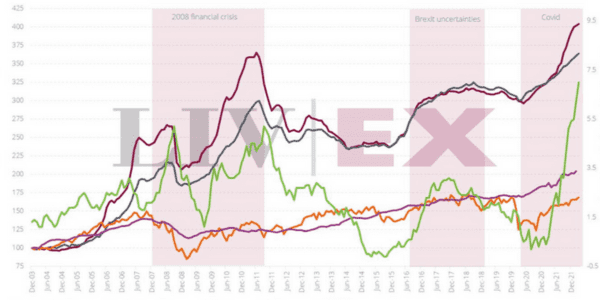
On the last day of 2010, Liv-ex published the results of the Liv-ex Fine Wine 50 Index. This indicator tracks the performance of 10 vintages of the 5 Bordeaux First Growths (Lafite, Latour, Mouton, Margaux and Haut Brion). For the first time in its history, it broke the 400 barrier, having been based at 100 in January 2004.

performance of wine investment in 2010


Fine wine as measured by this index in 2010 outperformed all other investment classes including gold and crude oil and made the S&P 500 and FTSE 100 pale in comparison. Even measured over 5 years time, wine easily shows the highest returns. 

See here for more information on investing in fine wine.  


Problems with the site? Please let us know

© Ditton Wine Traders 2008-2012

site developed by Mark Iliff, Talespinner