Ditton Wine Traders’ fine wine blog
September 2011
28/09 Why Bordeaux Fine Wine prices are falling • 12/09 Lynch Bages ratings revised by Robert Parker • 07/09 Fine Wine Market update and outlook • 06/09 Aussino continues to work with Bordeaux • 05/09 The 2010 primeur campaign and China
28 September 2011Why Bordeaux Fine Wine prices are falling

by Mark Schuringa
There’s always loads of noise and comments on blogs, websites and Twitter when Fine Wine prices are going up, often amounting to plugging one’s own business. As of the last month or 2 though, I have not seen many comments on the current state of affairs in the fine wine market, whilst there’s more need for that than ever. So we thought to have a stab at explaining the market and provide readers with some transparant, meaningful information.
Being on the forefront of the fine wine trade, we have a pretty good understanding of market forces. In our team, there’s thorough understanding of not just fine wine, but of luxury markets, of macro-economics and of financial markets. So we’d be pretty well positioned to make coffee out of all what’s happening in the fine wine trade. However, we don’t have a crystal ball so don’t sue us if we get this wrong. And like Keynes said, “in the long run we’re all dead”.
Facts
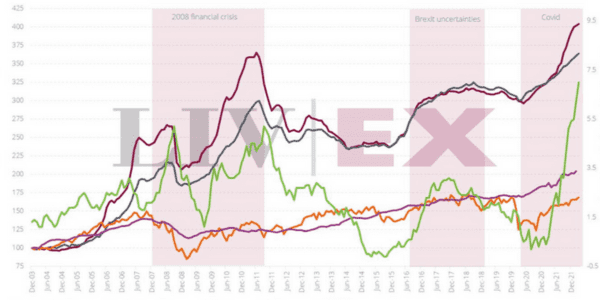
At the moment, prices of Bordeaux investment wines are coming down. From the top, late in June, to now, the benchmark Liv-ex 100 has fallen 13%. There is demand, for sure, but buyers need a discount. The market has transformed from an extreme sellers market into a buyer’s market.
Looking wider than the Fine Wine market, the broader financial markets are in turmoil and have fallen as a consequence. Uncertainty, fear even, seems to rule. No less than £75 billion was taken out of the equity markets since April, more than in the same amount of months post Lehman in 2008. As long as the possibility of Euro members defaulting, and all ensuing consequences to global economic growth, loom large, investors struggle to get their valuations right. Not to mention the risk of major, developed economies falling back into recession. In comparison, fine wine is doing relatively well.
Forecast
The million-dollar question is, of course, where this will all lead. Rephrase, where this will all lead to in the short term, because in the longer run, the fundamentals for fine wine investment are still in place. It takes more than temporary oversupply, or even a massive new market like China, to structurally dislodge the fundamentals of top fine wine. There simply is not enough supply for demand. At the moment though, there are some conflicting forces at work. Right now, the “bear/against” camp is winning the battle, but our belief is that the “bulls/for” side will win the war. Please see below for our thinking behind that.
Fine wines prices will slide further
The bear camp would say that Fine wine prices have gone up way past their historical average. Therefore, a correction is long overdue. In fact, 13% is not much of a correction. In comparison, in the autumn of 2008, the market came down by 25%, after which the index increased by 80%. We will need to see another 10-15% at least before we get back onto a sustainable path.
Furthermore, they'd argue, a major driving force of the last 3 years or so has been Chinese demand. Whilst we all thought that every single bottle sold to China was immediately necked for lunch, it now becomes apparent that this is not the case. It’s not all being consumed, "they" do not drink it all. Although a disproportionate amount of expensive wine does get consumed. At the moment, Chinese traders hold too much stock, bought when prices were going up, with the aim of selling it at a later stage. This “clog” needs to clear the pipeline before prices can move up again.
But, the bears argue, that might take a long time as the Chinese consumer is not prepared to pay ever increasing prices for Bordeaux, particularly now that they are getting more interested in other regions that make equally good wines. This might not hold true for 1st Growths, but it could well have an effect on other Classed Growths.
Finally, due to fine wine now being an investment vehicle, the market is much more volatile. Swings can be much more severe than we’re used to. When stockholders get nervous, a massive supply can suddenly hit the market and erode confidence.
Fine wines prices will soon start rising again
The bulls see it differently. The fundamentals are unchanged. Supply is still very limited in relation to demand, it's finite and impossible to increase. Luxury markets worldwide are booming. That is a trend forecasted to grow and continue for many years. A blip in confidence, a recession even it if comes to that, will not change that. Demand therefore will be larger than supply and we know what that does to prices.
Furthermore, the Fine Wine market is about 1/15th the size of funds leaving equities in the last 4 months. All that money needs to go somewhere and SWAG’s (silver, wine, art and gold) see a piece of the action. Even if only 1% were to go into wine – £750m – that would be roughly 15% of annual fine wine turnover and more than enough to have large implications on prices and availability. Don’t underestimate the influence of wine investment, it’s massively important, particularly in the UK, the US and, dare I say, in HK.
The relative lack of demand we currently see is temporary, healthy, and largely the result of fear on the financial markets. Once there is a sense that European leaders start sorting out their mess, once more people start calling the bottom, then uncertainty will make way for a sense of perfect timing to get invested. And the bulls think that will have a direct effect on Fine Wine. All we need is an important party to start buying. In fact, judging by today’s activity, that moment might have come.
A word of warning
Message to the Bordeaux chateaux owners: don’t be greedy. Don’t kill the goose with the golden eggs with unsustainable pricing. The 2010 Primeur campaign did not go down very well, not with Le Place, not with merchants and certainly not with consumers. These are the people that pay your bills, so please, make sure the next En primeur campaign will see much lower prices. If it doesn't, you risk damaging the whole concept of buying En Primeur.
Another, potentially even bigger danger is counterfeit. This is a real problem in China and has the potential to destroy any faith investors have in provenance. As long as we can’t be 100% sure that stock coming from Asia is genuine and has been properly stored at every point in the supply chain –something which is not currently the case – it should not be touched. In fact, assuring provenance should be given more attention as it is, even without the counterfeit issue. Encouragingly, there are more and more initiatives being taken to improve on that, which ultimately will be an enabler for Fine Wine to become a widely accepted alternative investment.
Concluding, there is a lot of uncertainty at the moment and nobody really knows what the outcome will be. Whilst above is only a snapshot of all arguments you can bring to the fore, both for and against, we believe there are strong enough reasons to conclude that the Fine Wine market is fundamentally in good shape and will soon see prices go up again. We have not quite reached the bottom, but we’re not far off. So, the coming few weeks might just present an exceptional buying opportunity for the brave.
We'd very much welcome your take on this. Let us know if you agree/disagree. Please posts your comments on our Facebook page. Go on, join the debate!
Categories: Investment • China • Bordeaux
12 September 2011Lynch Bages ratings revised by Robert Parker

by Mark Schuringa

and James Swann
In a vertical tasting of Lynch Bages vintages spanning 1981 to 2010, Robert Parker – the wine trade’s most influential critic – has conducted an extensive review of one of Bordeaux’s most enduring chateaux, re-rating the wines accordingly.
Perhaps unsurprising, this has lead to some price adjustments as well as a spike in activity. Why this particular chateau was chosen, while not explicitly referred to on Parker’s website (erobertparker.com), quite likely has to do with Lynch Bages’ enduring popularity, not just both sides of the Atlantic, but, of late, as one of the handful of chateaux taking the lead in China-and Hong Kong. Furthermore, the chateaux, which has consistently punched above its fifth growth weight, has (along with its ‘flying fifth’ peer Pontet Canet) seen a significant re-positioning in the market of late. The pricing appears to be holding, even in the recent climate of price drops. Lynch Bages is arguably the strongest Bordeaux brand behind the 1st Growths, with very strong trading volume, so this re-rating is well worth having a look at:
Lynch Bages re-rated
| vintage | new rating | previous rating | change | price |
|---|---|---|---|---|
| 1989 | 99 | 95 | +4 | £3,000 |
| 1990 | 99 | 97 | +2 | £2,900 |
| 2000 | 97 | 95 | +2 | £2,000 |
| 2010 | 95-97 | 95-97 | 0 | £1,250 |
| 2009 | 94-96+ | 94-96+ | 0 | £1,300 |
| 2003 | 95 | 89 | +6 | £1,150 |
| 2005 | 94+ | 91 | +3 | £1,100 |
| 2006 | 94 | 92 | +2 | £925 |
| 1986 | 94 | 92 | +2 | £1,350 |
| 2008 | 93 | 93 | 0 | £900 |
| 1996 | 93 | 94 | -1 | £1,450 |
| 1982 | 93 | 94 | -1 | £2,800 |
| 1999 | 90 | 90 | 0 | £900 |
| 1985 | 90 | 92 | -2 | £1,700 |
| 1995 | 89+ | 91 | -2 | £1,400 |
| 2007 | 88 | 89 | -1 | £780 |
| 2001 | 88 | 89 | -1 | £950 |
| 2004 | 87 | 89 | -2 | £850 |
| 2002 | 87 | 88 | -1 | £900 |
| 1998 | 87 | 89 | -2 | £1,000 |
| 1981 | 86 | 85 | +1 | £850 |
| 1983 | 81 | 89 | -8 | £950 |
In total, 8 vintages received a higher score and 10 vintages were downgraded. The 1989 and 1990 duo both now have 99 points, which caused many traders to snap up the few remaining cases they could find. The prices as stated reflect this. The 2003 vintage, of which it's a bit easier to find stock of still, received the biggest upgrade. Before the new score, the market price was around £850 whilst you'll do well to find it at £1,200 now. Even so, we feel this vintage will go up in price further as it is now one of the highest scoring vintages and availability will rapidly decrease.
The 2009 and 2010 duo also seem to be attractively priced, given enough time. Looking at above list, we feel that any vintage receiving more than 90 points and trading below £1,000 is also a buy. This is true for the 2008 but particularly for the 2006.
Have a look at our list of Lynch Bages. It's becoming increasingly difficult to source Lynch Bages, even the younger vintages so if above appeals to you, don't wait too long.
Categories: Investment • Bordeaux
7 September 2011Fine Wine Market update and outlook

by Mark Schuringa
Now that what seems to have been a very long summer break is over, it’s time to catch up.
The Fine Wine Market
Immediately after the En Primeur campaign finished early July (!), activity dropped right off. July still saw relatively brisk trade, but August was very slow, slower than recent years. Partly due to the trade having had quite enough of the long drawn Bordeaux En Primeur season, partly because of the holiday season, but mostly because of the uncertainty on the financial markets, coming right in the holiday season. There was not much demand and, as some stock holders preferred cash over paper profits, there was a steady stream of supply. As a consequence, prices dropped (more on this to follow). Particularly because First Growths led the way, and because we haven’t seen any monthly price drops for quite some time now, questions were being asked as to whether this could be the correction that has been predicted by many. The high prices of 2010 Bordeaux seemed to further fuel this thought, not unlike boom before bust. Speaking of the 2010 vintage:
The 2010 Bordeaux En Primeur campaign
Was long. Very long. High quality wines, high prices, big ego’s, long waits. We have covered this subject quite a bit on the blog, so for details please check the blog archive. Our opinion is that it was a very badly managed campaign, with basically all players in this market bar the Chateaux feeling hung over, the consequences of which we might well feel in the years to come. Ultimately, the concept of selling future wines needs to work for all parties involved, something which was not the case in the 2010 campaign. A shame really, because quality wise this vintage deserved much better.
What is interesting to cover is whether the 2010 campaign was successful in terms of sales. The answer depends on who you ask. The Chateaux had a bumper year, no doubt. I believe the French Negociants did do ok, although they were faced with a high risk of being left with very expensive stock. Remember, the Negociants pretty much have to take their historical allocation off the Chateaux, so they bear the risk, not the Chateaux. They sold through relatively well, although remaining stock must be higher than in 2009.
Because, overall, consumers were not nearly as excited about 2010 as they were about 2009, it was the “secondary” trade (merchants around the world) that was left holding much more stock than wanted. Or, if not, at the price of reduced future allocations. The consensus seems to be that 2010 sold about 40% of 2009 (which admittedly was an incredibly successful year). Importantly, sales were at a historically very low margin. There was lots of discounting going on, anything to sell the allocations one wanted to keep.
Up until the last 2 weeks of the campaign (until Vinexpo), Ditton Wine Traders were actually up on 2009, by a whopping 60%. Early on in the campaign, there were great wines to be had, at decent prices, something we did much more successfully than in 2009. Over the whole campaign, we sold 20% more different wines than in 2009. The last 2 weeks, when the 1st Growths and most super seconds were released, were not as successful as 2009 though, resulting in the end in a turnover of 78% as compared to 2009. When compared to most other UK merchants, we did extremely well. Although I don’t think this justifies being occupied with En Primeur Bordeaux for 2 months… Something to think about for 2011.
Fine wine prices
Starting in July and accelerating in August, most prices have come down. As measured by the Liv-ex 100 index, prices have decreased by about 6% in July and August. First growths, as measured by the Liv-ex Investables index, have done slightly worse, printing a fall of 7%. This was mainly caused by Lafite (see Liv-ex article), another major contributor being Parker’s downgrading of 2008.
What has caused this drop in prices? In our humble opinion, 3 main reasons.
Firstly, it seemed a natural moment for people to cash in on the profits they made over the last years. Well before the Primeur campaign, there was already lots of talk about price rises being unsustainable. It’s quite natural that people want to cash in on very handsome profits as they sense that the market might have reached a peak. Consequently, a lot of stock came onto the market.
Secondly, this boost in supply coincided with the holiday season and, importantly, the fact that the international fine wine trade was still holding a lot of stock, bought at cheaper prices. In particular the Chinese traders – we believe – held a lot of stock, bought when prices were going up ferociously. Note though this weak demand does not necessarily have anything to do with demand of the final customer (be it drinkers or investors).
Finally, the timing coincided with a general feeling of uncertainty, generated by another looming recession, continued systemic problems in the EU and resulting, massive falls on the financial markets.
Fine wine as alternative investment
First of all, we have to see this price drop in perspective. During the same period (July-August), the FTSE has lost 10% of its value, the German DAX even 17%. The financial markets have seen turmoil reminiscent of post Lehmann in 2008, with some very fundamental issues that have so far proven to be impossible to solve adequately. Given that Fine Wine is now, to a significant extent, an investment vehicle, it’s actually a remarkable resilient performance. From first hand experience, it’s clear that a lot of money is being swapped out of bonds and shares, into alternative investments like Fine Wine.
Secondly, no market can keep going up. If it would, there would be the mother of all corrections at some point. It is actually very healthy that prices have come off a bit. It allows for a period of consolidation, reflection and normalization. Which ultimately avoids boom/bust scenario’s.
As for demand of the final customer, September sees more activity again. UK investors are once again keen to invest in wine. Our customers in Asia are definitely back to buying, albeit more selectively than early in the year. We don’t see any indication that there could be a fundamental shift in the total level of demand, which – if true – will keep in force the age old adagium that demand outstrips supply.
Movers
Stock picking is very important and even more so now that there's a distinct gap in performance between several "classes" of wine. At the moment, there is a trend towards super seconds and "flying fifths" as well as cheaper Grand Cru Classees. It’s no longer anything 1st Growth and their 2nd wines.
As predicted on our blog a few months ago, customers are more aware of value for money. Although, at the same time, the truly iconic wines and vintages keep on doing well (as always).
At the same time, investment money is still flowing in. Wine investment funds and, to a slightly lesser extent, investment brokers make sure their portfolio’s are constituted of at least 50% 1st Growths, in some cases even 100%. These companies need to buy stock, there’s only limited supply, so we expect the current fall in 1st Growth prices to be reversed in the very near future.
On a final note, we do see growing demand from Asia for super Italians, as well as for Burgundy and indeed some New World regions. As this fabulous part of the world gets more acquainted with fine wine, and as prices of their first choice (often most iconic) wines go up and up, it’s natural and healthy that the eye is being cast on other wine regions that make great wine.
Our Picks
Not everything has come down in price. Some wines are actually up (Lynch Bages, Cos Estournel, Montrose, Pontet Canet). La Mission Haut Brion has had an incredible run. There's a lot of coverage on the performance of the "super seconds" and "flying fifths" as well as some of the cheaper GCC. The common factor with these wines and the reason behind their succes is that they are all well known brands, that they have made stunning wines in 2009 and 2010 as well as in some older vintages, and that their prices do not (yet) reflect the quality. We'd be very happy to advise on them, so if that strikes a cord, do get in touch.
Worth an extra mention is that Robert Parker has recently conducted an extensive vertical tasting of Lynch Bages, spanning 1981 – 2010, re-rating the wines accordingly. The market has already reacted, but it's likely that some vintages of what's arguably the strongest brand behind the 1st Growths will continue to do very well. We will cover this in our next blog post.

Finallly, something else to take notice of, is the "Magical 20" as selected by, again, Robert Parker. On November 8, he will conduct a tasting of "estates that produce wines of "first growth quality" although technically not first growths...and because of that are under-valued and very smart acquisitions". This might well have some effect on prices. Here's his list:
1. Ch. Cos D'Estournel,
2. Ch. Pontet Canet,
3. Ch. Pichon Lalande,
4. Ch. Leoville Poyferre,
5. Ch. Leoville Las Cases,
6. Ch. Palmer,
7. Ch. Malescot St.Exupéry,
8. Ch. Pape Clement,
9. Ch. Haut Bailly,
10. Ch. Angelus,
11. Ch. Trotanoy,
12. Ch. La Conseillante,
13. Ch. Pichon Baron,
14. Ch. Lynch-Bages,
15. Ch. Smith Haut Lafitte,
16. Ch. La Fleur-Petrus,
17. Ch. Clos Fourtet,
18. Ch. Rauzan-Ségla,
19. Ch. Brane-Cantenac,
20. Ch. Le Gay
So, enough reason to expect this trend for value to continue. Go for well known, non 1st Growth names with high scores. And don’t forget to stock up on 1st Growths before they go back up again.
Categories: Investment • China • Bordeaux • En primeur
6 September 2011Aussino continues to work with Bordeaux

by Mark Schuringa
Aussino clarifies Bordeaux position.
In July this year we published an article commentating on a report at decanter.com that Aussino, a major mainland China retailer, had determined to stop working with the Medoc classed growths, apparently due to over-heated prices. Aussino has since published a statement on its website to the effect of disqualifying the reported position, leaving no doubts as to the retailers continued support for top Bordeaux.
Dear all,
The recent article in decanter.com was a result of misunderstanding between the Decanter journalist and Grace Cai during their conversation. Aussino management announce that we are not changing policy to work & promote Bordeaux wines.
As the pioneer of wine culture promotion and education in China, Aussino has devoted itself to the long term partnership with many Bordeaux Grand Cru Classé Chateaux, which has been widely known and well appreciated. Also Aussino works with numerous Bordeaux GCC wineries as important business partner in China market as long term strategy.
We have published and republished the Aussino Wine Stories since 2000. The sixth edition is set to release in September 2011. The book, one of the most popular and best-selling wine books in China after 10 years of marketing cultivation by Aussino, introduces the stories of famous wineries worldwide including numerous Bordeaux Grand Cru Classés for the Chinese reader.
On the other hand, Aussino has also organized a great numbers of Grand Cru Classés dinners in mainland China since 2000. Aussino Wine Life, one of the most influential wine industry magazines, reports on every Grand Cru wine dinners. More than 50 Grand Cru wine dinners will be organized in different cities in the second half of 2011.
Aussino will keep on devoting tremendous effort and investment to cultivate the wine market in China. We will continue to work with our quality suppliers worldwide and of course including our partners of Bordeaux to introduce wines with high quality and good value to the Chinese consumers.
Best Regards,
Aussino World Wines
19th July 2011

Categories: Investment • China • Bordeaux
5 September 2011The 2010 primeur campaign and China

by Mark Schuringa
We found this interesting article on Wine Spectator: "Did China really save Bordeaux?" It gives some further insight into the success or lack thereof of the 2010 Bordeaux En Primeur campaign, and the role of Chinese /HK buyers:
Throughout this summer's sales campaign for 2010 Bordeaux futures, as châteaus released their wines at record prices and a number of loyal customers in America decided to pass, most analysts believed China would make up the difference. Thirst for high-end Bordeaux among China's wealthy has been growing for five years. This was supposed to be the year China came through for Bordeaux, leading to one of the most lucrative futures campaigns ever. If only it were that simple.
“We had a really good campaign,” said Jean-Pierre Rousseau, managing director of the négociant Diva. "We did as well as last year [value-wise]. But overall, we sold much less wine—fewer brands and less volume of each brand. And we also kept less wine than last year."
Several sources told Wine Spectator that yes, this was the most profitable futures campaign ever and China deserves a large amount of the credit. But the campaign was not the blockbuster many had hoped it would be.
Bordeaux’s top producers released the 2010 vintage at record prices, but the châteaus’ pricing strategy backfired in several ways. Merchants said that while some top names sold easily, other past bestsellers were not in demand. To move the wines, négociants would only give clients the top wines if they also took the others. Clients refused to hold onto “grossly overpriced” wine, and there was widespread discounting to quickly move the “toxic” brands out the door.
As for China, many châteaus priced themselves out of America and Europe and failed to attract the Chinese. “It would be wrong to say that Chinese customers have jumped at buying everything. That is not true,” said négociant Philippe Laqueche, general manager of Yvon Mau, whose 2010 campaign profits topped the 2009 campaign. “I think the campaign showed the strength of brands.” Pontet-Canet, Pichon-Baron, Beychevelle and Grand-Puy-Lacoste flew out the door. Smith-Haut-Lafitte, Rauzan-Ségla and Figeac, not so much, according to leading merchants in London and Hong Kong.
According to one broker’s report, 365 wines were released as futures during the 2010 campaign, with 89 percent of the allocated cases finding buyers. That’s the same clearance rate as the 2009 campaign, but fewer wines—403 wines sold during ‘09—and a far cry from the 93 percent clearance rate on 436 wines sold during the 2005 campaign.
Some merchants did well. ASC Greater China, a leading fine wine importer with 23 offices in China, increased its purchases but still only took a fraction of the offer. “We bought about 70 labels, of which 30 to 40 were for China and the rest were for Hong Kong,” said Don St. Pierre, Jr., CEO of ASC. “In total we purchased 90 percent more by value than we did last year and our total quantity was up by at least 70 percent. We took all the normal allocations and tried to get more allocations for the key wines that have demand and recognition in China.”
Demand for those key wines is fierce, and prices aren’t likely to come down unless the Chinese suddenly stop giving wine to business partners and high-ranking government officials. “The wine used for these purposes has to be famous and well-known in China [such as Lafite Rothschild]. Otherwise the gift giver or host may lose face,” explained Hong Kong businessman George Tong, whose own 2010 shopping list included the first-growths, second-growths, Le Pin and Pétrus. “If someone presents a bottle of Penfolds Grange or Harlan Estate as a gift or hosts a dinner serving them, he will lose face. They are very fine wines, but few people in China know them.”
But ongoing Chinese demand for other wines is less certain, particularly since China's nouveau riche were forced to take wines they didn’t particularly want in order to get their hands on the Lafite and other must-have gift items.
Nor did Chinese companies appreciate the disorganized tempo of the campaign—snail-paced at first, then frantic at the end, with 35 estates releasing in a single day. Pricing and tempo left private investors, a growing segment in China, disenchanted. “If prices drop later, everybody will be upset,” said Bandy Choi, a Macau and Hong Kong retailer who provides wine investment training to Bank of China executives.
Speculators are also muddying the waters. “We see quite a few wines that are not selling so well yet in China, but because of demand in Hong Kong the perception is they are very popular in China,” said St. Pierre. “We think most of the speculation is coming from brokers in Hong Kong and the U.K., betting on the next big thing. But since none of these companies have much of a presence in China, they are really very far away from reality.”
Aside from the seasoned importers with strong distribution networks like ASC and Aussino, most of the Chinese buyers, many of whom are large corporations who would just as happily import scrap leather, are worried about the next step: turning a profit. “They bought in '09 and haven’t seen any profit and now with 2010 they question if they will see profit again, so they are right to be cautious,” said Doug Rumsam, managing director of Bordeaux Index (HK). “Time will tell as to how these corporations offload these wines and the success of their long-term strategy.”
At its essence, the futures game is one of opportunism, nowhere more so than China. “If the Chinese cannot make big money in the primeur business, they will quit,” said Laqueche. That is particularly worrisome, because a large amount of Bordeaux’s grand cru classé now goes to China and Hong Kong. “The new concern over the long term is the geopolitical balance of wine,” said Laqueche. “Shifting from loyal customers to new customers—that’s an upside-down way of thinking. Perhaps it’s a historic move but it’s a dangerous one. We need to maintain traditional markets.”
Some négociants hope that Americans will begin buying petit châteaus priced between $15 to $35. But those wines aren't well-known in the U.S. “There really is not much of a petit [château] market,” said James Gunter, senior vice president at Glazer's, a major U.S. distributor. “Négociants want to sell them, but do nothing to promote them or help sell them and build in the marketplace. Estate owners really don’t get marketing and promotion in the U.S.”
Which means Bordeaux may be putting all its eggs in China's basket before it truly knows—or understands—the Chinese market.
Unquote. Now that the holiday season is finally over, we will shortly give our take on the campaign as well as the current market. Watch this space.
Categories: Investment • China • Bordeaux • En primeur


English
中文 (葡萄酒和博客用英語)
日本語 (ワイン在庫表&ブログ)