Ditton Wine Traders’ fine wine blog
December 2011
15/12 Waiting for the right moment to buy fine wine • 08/12 All about fine wine funds and auctions • 07/12 Wine investment, what Warren Buffett would do
15 December 2011Waiting for the right moment to buy fine wine

by Mark Schuringa
In one of our previous articles, “Wine investment, what Warren Buffett would do”, we announced we would elaborate on the prevailing uncertainty in the fine wine market and shed some light on short term demand.
We have repeatedly commented on the fundamental health of the fine wine investment market. We believe there are many reasons why fine wine continues to make a good investment. Following, we also think the current lull in prices – caused by short term supply and demand issues and extreme macro-economic uncertainty – presents an opportunity.
The potential of the current situation in fine wine
Firstly, as covered on the blog, the fundamentals look good.
Secondly, a major reason for the current fall in prices is oversupply in China. It will take time for that to resolve itself, but as demand is still there, this in the end is a temporary factor, not a fundamental one.
Thirdly, war chests are building up. Because the fundamentals are sound, there is a “wall of money” waiting to be employed – as commented on in the previous post. Waiting for the right moment. The people managing this money can see the opportunities coming and they prepare themselves to take advantage of them. Why do we think this is the case?
- The long term average return on fine wine is very compelling, particularly in combination with the relatively low risk.
- The fine wine market is on course to become much more professional and efficient, which will attract more money
- Fine wine has to an important extent become an investment market. Participants – wine funds, collectors and big merchants – will act to make a profit if they see an opportunity.
- Any significant upsurge in demand will lift prices as the fine wine market is small (only £4bn per annum). Potential demand is infinitely bigger than supply.
Signs of the market turning
In addition, being involved in trading wine every day, we see more and more signs that point towards prices bottoming out:
- There are less good deals to be had – sourcing well is becoming difficult.
- More and more people are predicting when and where the bottom will be
- Indeed: the first players are stepping in. There are wines that are being picked off. There are also large outstanding orders to be filled.
- Not all is going down – Burgundy, Yquem and some Italians being a case in point.

So what needs to happen for this money to be put to action? In short, a sense that the bottom of the market can be called. Since fine wine is more and more behaving like financial markets, this has all to do with uncertainty. One major driver of uncertainty is what “our friends” in Europe do.
In “normal” economic circumstances, fine wine is not really correlated to the various economic and financial gauges or asset classes. However, in times of financial stress, all asset classes become very closely correlated. Here’s the point: once the markets find their bearings again, fine wine will become less correlated again and is expected to do well. The wider economy might well languish for a sustained period of time, but that might actually play into the hand of fine wine investment, which after all is an alternative investment.
On Europe – it’s all about uncertainty
For 2 years now, the Eurozone crisis has been moving towards crunch time/end game. Forget all the talk and even financial market demands. After all is said and done, if you strip it down to the core, the problem is that the euro-zone is made up of countries that are not equally efficient. In producing goods and services, and in running their countries budget. This would be fine if these countries had their own currency as that would act as a stabilizing mechanism. Inefficient countries would still be able to compete, because their currency – vis a vis their more efficient competitors – would depreciate, making their output more affordable and competitive. But they don't, they share the same currency.
Europe, on the 9th of December, has finally and for the first time, made moves towards a fiscal union. Right from the word go, at the Maastricht treaty 20 years ago to the day, we all knew that was required to make a monetary union (one currency) work. Therefore, the 2 year old crisis seems to have turned a corner. From now on, we’re talking about the real stuff and there’s no hiding.

Which makes one think about the next phase. What will happen to the less efficient Eurozone countries? On country level, overspending is no longer an option, they’ll have to live within their means, no short cuts. On company level, how is a Greek battery manufacturer going to compete with its uber-efficient German competitor? Let’s face it, he’s not. There is no way the Greek will be as efficient as the German. With all due respect, it’s just not going to happen. Given they share the same currency, the only escape is to become more competitive, by lower wages and very likely increased unemployment. Which will be painful and quite possibly unsustainable, as that would put the onus back onto the government, who now don’t have a way out anymore.
Were Greece isolated from international capital flows, it could work. But they’re not. Lower wages, in the face of prices of a lot of products being set outside of Greece would lead to real loss of disposable income. Recession would be the likely result. The government would be forced to tighten its belt further, exacerbating the problem. Vicious circle.
It will be a really tough call for the economically weaker countries (the PIIGS, or Garlic countries – no offence) to do well for themselves within a euro-zone that enforces fiscal austerity. There will be a temptation to escape that harness, possibly by reverting back to their own currency. Or maybe even a “garlic currency”. Whilst this would be a rocky ride for sure, it’s not as bad as an uncontrolled implosion. What matters is that the one and only sustainable step to take for the euro-zone to be resolved and for the euro to survive, is for them to move towards a fiscal union. And we have now embarked on that road, hallelujah. Onwards and upwards.
Whilst very early days, the major fundamental source of uncertainty has finally been addressed. Surely there will be more crises, but at least they will be focused in the right direction and as such move away from full out disaster scenario’s. That is an important ingredient for more confidence and less uncertainty.
Financial markets are not yet convinced
Whilst most analysts will probably agree with the point we make above, they are more concerned about the short term risk of a bank crisis. In short: the risk of banks running out of money, because they are running out of collateral needed for the ECB to lend them emergency funds. If that happens the banks would probably need to be nationalized. Nationalized by a sovereign that doesn’t have money itself, leading to a worsening of the sovereign debt crisis. Again, a vicious circle.
What would be the solution, the circuit breaker? As BBC’s Robert Peston says: “It's the same as it ever was: mutualisation of all the eurozone's debts, which in practice means that the mighty German sovereign balance sheet would stand behind the enormous liabilities of the rest of the eurozone ….. but that won't happen unless and until there is an all-powerful finance minister (in effect) for the whole of the eurozone, to reassure Germany and the German people they wouldn't be throwing good money after bad.”
Perhaps there are other solutions as well (Peston is always gloomy), which quite likely will involve the ECB. But quite clearly, this is the biggest short term uncertainty that needs to be taken care of.
Concluding:
If our analysis is correct, this is what will happen. Economic uncertainty will slowly diminish and a sense that we’ve seen the worst will start to prevail. Once that happens, the first Buffett’s will enter the market, which no doubt will be the bigger, professional players in the market. That will stabilize prices and the most sought after wines and vintages will start to go up again. This in turn will encourage other players to step in, including new money that has not previously been employed in fine wine and is attracted by both the fundamentals and the prospect of the fine wine market professionalizing. But what is needed for this to happen is a nascent belief that the European banks will not fail.
When? Not long now… All eyes on Signore Draghi.
Final thought
A few things. Remember what happened on the financial markets in the Spring of 2009. It doesn’t take a whole lot for an upsurge in demand to lift fine wine prices. Buffett’s quote “We simply attempt to be fearful when others are greedy and to be greedy only when others are fearful”.
Wouldn’t it be nice if we can once again focus on wine, rather than finance?
Categories: Investment • Bordeaux • Burgundy
8 December 2011All about fine wine funds and auctions

by James Swann
In this latest piece we look at the emergence of new actors in fine wine markets, by way of wine funds and the increased prominence of fine wine auctions.
In a series of questions and answers Ella Lister, the Auctions and Secondary Market Correspondent for the World of Fine Wine Magazine (WFW) provides critical insight.
New routes to market for the collector and investor
Until James Miles, Director of Liv-ex (the London International Vintners Exchange), put a figure to it at the Hong Kong International Wine & Spirits fair, estimates of the value of the world-wide fine wine market saw swings by as much as 100%. The figure Miles arrived to was $4 billion and one that has been referred to since. As Miles pointed out, this is composed of merchants (90%) and auction houses (10%), but not other actors, such as wine funds or financial entities holding wine as an investment.
Importantly, private collectors and investors, with whom most stock resides and who may freely sell or broker their wines independently, are not included within this figure. Thus, the real value of the fine and rare wine market must be significantly higher.
In the 10 years since the trading platform began, the fine wine market has changed dramatically, to the point where fine wine is well on the way to being accepted as a credible alternative investment. The 2008 decision by the Hong Kong government to go from a closed to open market, by reducing its 50% tariff on wine to zero overnight, ushered in startling expansion and is the most disruptive event since the entrance of the US market in the 1970s or the arrival of the internet and transparency.
The historic fine wine trade structure – centred on the traditional merchant, collectors and auction houses – has changed too. London fine wine merchants successfully established broking divisions in the expansive environment of the early to mid-1990s, which saw Asian buyers enter for the first time. Trading platforms, led by Liv-ex, and price tools like wine-searcher.com followed and have brought transparency to a hitherto remarkably opaque market place.
We may not have given it due attention at the time, but this marked the first meaningful step in the little-by-little sophistication of fine wine markets. New actors – professionally managed wine funds and a freshly dynamic auction scene among them – mean there are now new routes to enter and exit the market for the private collector and investor.

A common feature of fast-growing, but immature markets is that a rush of new money can push up value beyond the line supported by the fundamentals. Moreover, where will this new capital go in the event of a stabilisation of stock markets; will it remain in fine wine or will it return to the traditional fold?
How important are these newly empowered actors to today’s fine wine markets?
Certainly, hammer prices and fund headlines suggest increasingly so. The former is a leading indicator of sentiment, albeit for the irrational luxury market, so important to that essential ingredient of economic prosperity, confidence. The latter? Well, we don’t know exactly. A large part of the challenge with wine funds is that, behind the headlines, facts would seem to be hard to come by. Yet, understanding the role of these new actors matters. Accurate and transparent figures, traceability and the human face are a pre-condition to the fine wine market taking the next step and becoming a mature and accepted form of investment as well as pleasure.

Wine funds and fine wine auctions – behind the headlines with Ella Lister
DWT How important are fine wine auctions and wine funds to today’s fine wine market?
EL The wine auction market steals the headlines but represents no more than ten per cent of global fine wine revenues, at almost $400 million annually in 2010. Similarly, wine funds are on everybody’s lips, but total assets under management are no more than $400 million, and probably nearer to $300 million.
DWT Are fine wine auctions a good route to market for the private collector/investor?
EL They can be very lucrative, but the seller has less control over the final price, as you have to commit stock months before the actual sale, and auction houses will restrict the reserve price you can apply. Hence some wine funds steer clear of this riskier route to market.

DWT What is the current growth trend among auction houses and what is their regional spread?
EL The auction market is growing fast, but probably not considerably faster than the overall fine wine market. Revenue in the first three quarters of 2011 was up 44 per cent on the same period in 2010. Hong Kong now represents just over 50 per cent of global wine auction revenues.
DWT There has been a lot of talk about new funds being set up. Is this true or exaggerated? What is their impact and is this sustainable?
EL There has certainly been a flurry of announcements in 2010 and 2011, but the actual level of success is so far unclear. For example, Société Générale and Bordeaux Index have both announced funds that have yet to materialise. Despite bold aims to raise RMB 1 billion in its original statement in August, the much talked-about DeRouge fund has made no further noise. We don’t know whether it has succeeded in raising its initial target tranche of RMB 200 million.
DWT Do wine funds buy en primeur?
EL Some do; some don’t – see my series on funds in the WFW.
DWT Would buying into a fund outperform purchasing a basket as represented by the Liv-ex Investable index?
EL It’s likely to be a similar basket! You would like to think that the fund manager’s expertise and careful ongoing analysis would yield higher returns, but this is not always the case.
DWT Fast forward five years: what are your predictions?
EL Wine funds will continue to play a key role in the fine wine industry, as investors look increasingly to tangible assets. However, the limited size of the fine wine market means that it’s hard to imagine fine wine becoming a major investable commodity on a par with gold or even fine art. After all, the most expensive case of wine is nothing compared to the most expensive painting. The market will continue to become more sophisticated and transparent, but in five, or even ten years’ time, it still won’t be ready for large-scale investments or complex financial products. It is a niche investment product, best kept in the realm of the tangible.
The final instalment of Ella Lister’s three-part work, examining the pros and cons of funds vs. DIY wine investment, is in issue 34 of the World of Fine Wine Magazine, out now.
Categories: Investment • China • Bordeaux • En primeur • Burgundy
7 December 2011Wine investment, what Warren Buffett would do

by Mark Schuringa
Since the Summer, fine wine prices have moved south. So have all bond and equity markets. Systemic risk caused by European debt issues is the main reason. Which in turn affects global growth prospects. Banks are forced to de-leverage, making it more difficult for companies and indeed countries to access credit. Credit rating agencies sound warnings left right and centre, with Standard & Poor’s in their latest move warning that it might downgrade the credit rating of no less than 15 European countries.
It’s mayhem, fear rules, there’s blood in the streets, everybody rush to the exit.
Which is exactly the situation that Warren Buffett loves. It provides him with the opportunity to buy solid businesses, with a proven track record, with low risk and high value, at a price he would otherwise never be able to buy at. When Buffett – arguably the most admired investor around – buys, he does so because he believes the valuations of the business he targets will allow him to generate a handsome and relatively safe long term return. Here’s one of his quotes: “We simply attempt to be fearful when others are greedy and to be greedy only when others are fearful”.

Now, Buffett would not move into fine wine investment – he would blow the whole market out of the water with £100bn to spare. It may, however, be instructive to try and transpose his thinking onto the fine wine market. The thinking of a value investor. Long term risk averse but short term willing to take a chance if the price warrants it.
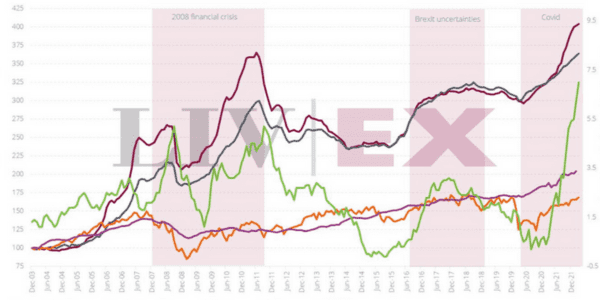
We have covered risk and rewards of the fine wine market before. To refresh your memory, here’s the chart:

15% annual return over 20 years with 11% risk, outperforming gold, silver, art and the FTSE100. With a supply and demand structure to die for: finite and diminishing supply with (potential) demand dwarfing supply. At the same time, the fine wine market is tiny: only $4bn per year, worldwide. It doesn’t take a lot for increased interest to lead to higher prices. Current pricing seems to be at a level where investors that believe in technical analysis could argue that it presents a buying opportunity.

The potential of wine investment
It gets better. The fine wine investment market has been and still is unregulated. Which holds back institutional investment, by not being allowed by the FSA (or its international counterparts) to get involved. These wealth managers would otherwise be very much attracted by the fundamentals of fine wine.
Furthermore, fine wine so far has been unable to attract serious alternative investment money, due to the unprofessional manner in which transactions are settled. The whole en primeur system, transfer of ownership, wine storage and the way stock is moved around to complete transactions; it's just not up to par – not by a long shot – with how financial markets are run and how professional investors demand transactions to be executed and governed.
Here’s the potential: Regulation and settlement will change. Although in an early stage, there are serious initiatives to take the fine wine market to a level where it will comply with institutional investment standards. It won’t happen overnight, but once it does, it will transform the way the fine wine market operates and it will allow for institutional investors to add fine wine to their alternative investment portfolio.
So, IMHO, what we have is a fundamentally attractive investors market, with in addition game-changing prospects that would for the first time make fine wine accessible to professional investors, at a time of extreme uncertainty that has resulted in depressed valuations.
Sounds like an opportunity Warren Buffett would love if you ask me. Take away the uncertainty and happy days are here.
More on uncertainty in our next posting – watch this space. We’ll also cover our views on short term demand and the funds that need to pay for that, as well as insightful tips from the trade.
And, remember to watch Merkozy on the 9th of December.
If you like this article, please share it with your friends and colleagues by using the buttons just below. Remember you can also like us on Facebook so you can keep up with all our articles, news and offers.
Some sort of disclaimer (loyal readers will know this). We like to express our opinion, because we want to provide our readers with information they can use. Our articles are not always extensively researched, nor do we claim for that to be the case. Having said that, many of our readers highly value our views and indeed consider them an authoritative voice, which helps to complete their understanding of the fine wine market. In compiling our articles, we draw upon a background in both macro- and financial economics, as well as being wine traders that are in touch – every day – with supply and demand. We do not take decisions for our customers to buy or sell certain wines. Although we will express our views, the end responsibility lies with the customer.
Categories: Investment


English
中文 (葡萄酒和博客用英語)
日本語 (ワイン在庫表&ブログ)