Ditton Wine Traders’ fine wine blog
category: China
14/02/2012 An Update on the India EU FTA • 25/01/2012 Wine and the India EU Free Trade Agreement • 08/12/2011 All about fine wine funds and auctions • 08/11/2011 A case for investing in fine wine, now • 31/10/2011 Is this the right moment to buy Bordeaux? • 28/09/2011 Why Bordeaux Fine Wine prices are falling • 07/09/2011 Fine Wine Market update and outlook • 06/09/2011 Aussino continues to work with Bordeaux • 05/09/2011 The 2010 primeur campaign and China • 18/07/2011 Aussino to stop buying Left Bank Bordeaux • 01/06/2011 Latour chases Lafite in Hong Kong auction scene • 14/02/2011 Savvy Chinese buyers looking beyond Bordeaux • 08/02/2011 Burgundy: start hoarding • 13/01/2011 Fine wine prices, bubble and currencies
14 February 2012An Update on the India EU FTA

by Mark Schuringa
As you will know from our previous blogposts, the EU and India have been trying to reach consensus on signing a Free Trade Agreement, which could have a significant impact on the (fine) wine industry. Hopes were high that, after 4 years of negotiating, an agreement would be signed last week.
It hasn't. Since this FTA covers a very wide range of industries and is highly political, it would seem the hurdles were still too high. The negotiating parties have not yet got what they want. In particular the car-manufactoring industry as well as generic drug manufacture seem to be the major, remaining obstacles.
Indian Commerce Minister Anand Sharma said the talks were in the "final stage" but a "few gaps" remained. EU Commission President Jose Manuel Barroso said that both sides expected the agreement to be signed by the Autumn and Herman van Rompuy, the European Council President said the EU and Indian leaders have made "substantial progress" towards a free trade agreement.
To illustrate how difficult it is to reach consensus, and how political this process is, even issues not directly related to mutual trade were considered. As a prime example, the Iranian issue was raised, with the EU pressing India to be more supportive towards the EU trade sanctions on Iran.
The bottom, rather frustrating, line: we will have to wait and see if and when this hugely promising FTA will (finally) be signed.
In the meantime, it will be interesting to watch what the big players in the fine wine business will do. Will they take a gamble and establish a foothold before anybody else does?
Categories: Investment • China • Blogs
25 January 2012Wine and the India EU Free Trade Agreement

by James Swann
Can we expect a boom in Indian fine wine imports?
A recent FT article discussed wine in India, for which Ditton Wine Traders provided a lot of the research. The interpretation of the potential for significant developments for fine wine in India left us and other trade actors, British or India, who contributed their views and analysis a little underwhelmed. We feel important aspects we’re not covered , so we’ve decided to elaborate further here.
India is developing into an open market economy, though important remnants of the autarkic policies that followed independence remain. For example, fine wine is constrained by a penal import tariff regime of 150%.
This could change as the EU and India are in the final stages of negotiating a Free Trade Agreement (FTA), negotiations for which have started in 2007.
Findings show there is arguably a 50-50 chance of a tariff reduction to be announced at the EU-India Annual Summit, February 10th. It may appear to hang in the balance, but Indian officials indicate they are prepared to make concessions within the framework of the EU. It is the single most significant piece of news ever in relation to India and wine, and the only development that could potentially lead to India fulfilling its potential as a mass importer of wine.
Will the EU-India FTA be signed?
India has FTA’s with some 60 countries, yet that on the table with the EU is both its most ambitious and difficult. The two sides have met some 14 times since initiating talks in 2007 and, it appears, are working towards a significant statement in time for the February summit.
“The potential (for wine) is tremendous, the ingredients are all there; wine is a cultural pursuit, an intellectual pursuit, India is an old culture, an old culture can better assimilate the traditions of another, it can be imbibed by the Indian population. The Middle class has grown up on a surfeit of education, it can reach out to,” affirms Sanjay Menon, owner of pioneering fine wine importers, Sansula.
Annual trade between the EU and India stands at $75 billion (£48 billion) (2009/2010), making the EU India’s most important trading partner. Beyond the trade-off between tariff reduction for EU exports and protection of Indian industries, notably automobiles and India’s fledgling domestic wine market, there are real issues behind the 5-year impasse. India wants access to EU markets through free movement of its professional émigres, highly sensitive for much of the EU. The EU meanwhile demands stronger implementation of Intellectual Property Protection for its transnational pharmaceutical industry.
Yet, the FTA is seen by both parties as too big to fall, negotiations have already reached the highest political levels before diplomats have had a chance to thrash out the details, a diplomatic blunder placing pressure to agree. Still, the fact that they are negotiating shows there are no guarantees.
What would agreement mean for fine wine markets?
There is no hard data on fine wine in India, as the market is beginning and under the radar (see below for upcoming blog pieces on Indian position towards fine wine and wine investment). However, analysis by Peter Wilkinson, Director of International Affairs for the Scotch Whisky Association, is instructive.
“If we look at spirits, member-states would not sign-up on the basis of less than a 50% reduction”, observes Wilkinson. India’s 150,000 9l case market (firm figures remain elusive) in imported wine (compare to China’s 2.5 million case market in Bordeaux alone) is growing at 12% per annum while spirits is around 15%. “A 50% reduction of the current rate might increase growth to about 20%-25% per annum”, he concludes.
However, continues Wilkinson, “the EU may try to secure a fair bit of front-loading as part of the deal, looking for a significant chunk of the total concession to be given over with immediate effect, with the remainder brought in within an agreed timeframe.”
Significantly, for fine wines, both the EU and India have indicated progress in the area of staggered tariffs for different quality-price levels of wine. Leaving the current fiscal position intact for value entry-point wines, while progressively reducing duty on higher-priced ones, the lowest tariff strata would, therefore, be applied to fine wines. This compromise would protect the development of the nascent and successful domestic Indian Wine industry, yet open the way for fine wines to reach India’s burgeoning middle class – the world’s largest.
How would the market respond?
Would we see an explosion in fine wine markets like what occurred with the 2008 decision of the Hong Kong government to reduce tariffs from 50% to 0% overnight?
Not in ways comparable to Hong Kong. Implementation, to be in line with peer-countries in the EU, Brazil, Russia or China to eventually 20%-25%, would likely be at stages over a period of 5 – 10 years. In the immediate-term however, the FTA could reduce the special tariff of 150% to 80%-90% for wines and spirits (the maximum standard excise duty within the bounds of the World Trade Organisation).
Yet, the Hong Kong precedent is in some ways comparable, by way of human behaviour. “The effect of halving the tariff on a society accustomed to 150% would be palpable. The market would react in ways not previously seen”, asserts Rajiv Singhal, Director Fine Publishing India and Ambassador to Champagne trade body, CIVC.
India will not be in a position to support falling prices or take up slack from over-supplied markets. Nevertheless, agreement would radically alter the entire outlook and dynamise the wine trade globally. The moment would be firmly behind India realising its potential as a major actor in the world of wine by entering the global market place. It would be fascinating and mark the continued expansion of fine wine markets to a new and more global clientele.
We will find out more in just a few weeks.
In upcoming blog pieces we examine the nascent Indian fine wine market and, significantly, culture around fine and rare wines and wine investment, in particular in comparison to China. Drawing on the experiences of peers and other trade actors – both Indian and British, pioneering a culture of wine in India.
Watch this space and feel free to share views. Follow us on Twitter @DittonWineTrade and join the debate online at #IndiaEUFTA
Categories: Investment • China • Bordeaux • Burgundy • Blogs
8 December 2011All about fine wine funds and auctions

by James Swann
In this latest piece we look at the emergence of new actors in fine wine markets, by way of wine funds and the increased prominence of fine wine auctions.
In a series of questions and answers Ella Lister, the Auctions and Secondary Market Correspondent for the World of Fine Wine Magazine (WFW) provides critical insight.
New routes to market for the collector and investor
Until James Miles, Director of Liv-ex (the London International Vintners Exchange), put a figure to it at the Hong Kong International Wine & Spirits fair, estimates of the value of the world-wide fine wine market saw swings by as much as 100%. The figure Miles arrived to was $4 billion and one that has been referred to since. As Miles pointed out, this is composed of merchants (90%) and auction houses (10%), but not other actors, such as wine funds or financial entities holding wine as an investment.
Importantly, private collectors and investors, with whom most stock resides and who may freely sell or broker their wines independently, are not included within this figure. Thus, the real value of the fine and rare wine market must be significantly higher.
In the 10 years since the trading platform began, the fine wine market has changed dramatically, to the point where fine wine is well on the way to being accepted as a credible alternative investment. The 2008 decision by the Hong Kong government to go from a closed to open market, by reducing its 50% tariff on wine to zero overnight, ushered in startling expansion and is the most disruptive event since the entrance of the US market in the 1970s or the arrival of the internet and transparency.
The historic fine wine trade structure – centred on the traditional merchant, collectors and auction houses – has changed too. London fine wine merchants successfully established broking divisions in the expansive environment of the early to mid-1990s, which saw Asian buyers enter for the first time. Trading platforms, led by Liv-ex, and price tools like wine-searcher.com followed and have brought transparency to a hitherto remarkably opaque market place.
We may not have given it due attention at the time, but this marked the first meaningful step in the little-by-little sophistication of fine wine markets. New actors – professionally managed wine funds and a freshly dynamic auction scene among them – mean there are now new routes to enter and exit the market for the private collector and investor.

A common feature of fast-growing, but immature markets is that a rush of new money can push up value beyond the line supported by the fundamentals. Moreover, where will this new capital go in the event of a stabilisation of stock markets; will it remain in fine wine or will it return to the traditional fold?
How important are these newly empowered actors to today’s fine wine markets?
Certainly, hammer prices and fund headlines suggest increasingly so. The former is a leading indicator of sentiment, albeit for the irrational luxury market, so important to that essential ingredient of economic prosperity, confidence. The latter? Well, we don’t know exactly. A large part of the challenge with wine funds is that, behind the headlines, facts would seem to be hard to come by. Yet, understanding the role of these new actors matters. Accurate and transparent figures, traceability and the human face are a pre-condition to the fine wine market taking the next step and becoming a mature and accepted form of investment as well as pleasure.

Wine funds and fine wine auctions – behind the headlines with Ella Lister
DWT How important are fine wine auctions and wine funds to today’s fine wine market?
EL The wine auction market steals the headlines but represents no more than ten per cent of global fine wine revenues, at almost $400 million annually in 2010. Similarly, wine funds are on everybody’s lips, but total assets under management are no more than $400 million, and probably nearer to $300 million.
DWT Are fine wine auctions a good route to market for the private collector/investor?
EL They can be very lucrative, but the seller has less control over the final price, as you have to commit stock months before the actual sale, and auction houses will restrict the reserve price you can apply. Hence some wine funds steer clear of this riskier route to market.

DWT What is the current growth trend among auction houses and what is their regional spread?
EL The auction market is growing fast, but probably not considerably faster than the overall fine wine market. Revenue in the first three quarters of 2011 was up 44 per cent on the same period in 2010. Hong Kong now represents just over 50 per cent of global wine auction revenues.
DWT There has been a lot of talk about new funds being set up. Is this true or exaggerated? What is their impact and is this sustainable?
EL There has certainly been a flurry of announcements in 2010 and 2011, but the actual level of success is so far unclear. For example, Société Générale and Bordeaux Index have both announced funds that have yet to materialise. Despite bold aims to raise RMB 1 billion in its original statement in August, the much talked-about DeRouge fund has made no further noise. We don’t know whether it has succeeded in raising its initial target tranche of RMB 200 million.
DWT Do wine funds buy en primeur?
EL Some do; some don’t – see my series on funds in the WFW.
DWT Would buying into a fund outperform purchasing a basket as represented by the Liv-ex Investable index?
EL It’s likely to be a similar basket! You would like to think that the fund manager’s expertise and careful ongoing analysis would yield higher returns, but this is not always the case.
DWT Fast forward five years: what are your predictions?
EL Wine funds will continue to play a key role in the fine wine industry, as investors look increasingly to tangible assets. However, the limited size of the fine wine market means that it’s hard to imagine fine wine becoming a major investable commodity on a par with gold or even fine art. After all, the most expensive case of wine is nothing compared to the most expensive painting. The market will continue to become more sophisticated and transparent, but in five, or even ten years’ time, it still won’t be ready for large-scale investments or complex financial products. It is a niche investment product, best kept in the realm of the tangible.
The final instalment of Ella Lister’s three-part work, examining the pros and cons of funds vs. DIY wine investment, is in issue 34 of the World of Fine Wine Magazine, out now.
Categories: Investment • China • Bordeaux • En primeur • Burgundy
8 November 2011A case for investing in fine wine, now

by Mark Schuringa
A case for investing in wine, now
As you will likely be aware of, prices of fine wine, as measured by the widely adopted Liv-ex 100, have fallen 20% over the last 3 months and the drop has not yet stopped. You might therefore think, why should I invest in a market that’s going down? You might also think that any advice to buy coming from a fine wine merchant should be taken with a pinch of salt or two, as they want to sell, right?
Well, yes, but more important to us is that our customers are happy and will return. Anyway, don’t take our word for it, have a look at below facts and information and do the interpreting of it yourself.
Investing in fine wine, a longer term view
Fine Wine (as measured by the Liv-ex Fine Wine Investables index), has shown an average compounded return of nearly 15% over 20 years time.

This significantly outperforms the FTSE 100, which over the same period of time, only returned 3.5% (!) Not only that, it also outperforms the other SWAG commodities / collectibles (Silver, Wine, Art and Gold).
What’s more, Fine Wine not was not only best of class in terms of return, it did that with the lowest risk:

The main reason for this impressive performance is the simple mechanics of supply and demand. Supply is finite and diminishing, whilst demand for luxury goods has been steadily increasing. Even well before China happened, the Western world had no problems at all soaking up all that the top 25 Chateaux could produce. Nowadays, the Chateaux produce 15% less than 20 years ago, whilst demand has greatly increased.
The fine wine market is still immature
Transparency has greatly increased with the internet, allowing for more reliable price setting (as well as lower profit margins for sellers). This process is likely to continue, with more and more online price checkers as well as professional exchanges being launched.
Furthermore, logistics and most importantly, proving provenance is very amateuristic, scaring away professional fund managers that otherwise can see the compelling case of investing in Fine Wine.
The relevance being that, as the market gets more transparent, regulated and professional, it will also become more interesting as an investment vehicle.
A point in case is China. An enormous amount of wine is being shipped to China, even though it’s largely brought into the country in an illegal manner, as duties and tax (at 50%) are on the whole being avoided. Many argue we’ve only seen the beginning of demand from China – once that market becomes more transparent, mature and liberal, that’s when demand will really start going.
But why buy now?
I think that the structural case for wine investment is quite convincing when you look at above information. Prices are still dropping though, so why should you buy at this moment in time?
One argument has to do with risk-return. The correction of 20% we have seen in the last 3 months, has taken the average CAGR (compound annual growth rate) nearly back to its 50 year average. Whilst there is of course a risk that this correction is not yet over, one could argue that the downside potential is far less than it was when fine wine was trading at historically high CAGR rates. Please see below graph – courtesy again of Liv-ex.

Chances are that, if we look back in say 5 years time, adding wine to your portfolio at this point in time, will not have been a bad time to do it.
Further to this point, let’s have a look at one of the most heavily traded wines of late, Lafite Rothschild 2008.
The price of Lafite 2008 is now back to where it was just before the massive speculation around the special bottle with the Chinese symbol started. At this level, it’s not far off the prices of its peers with similar scores. The point? Again, that a lot of the risk of Lafite 2008 dropping in price has been taken out already.
Mouton 2008 by the way follows exactly the same pattern. There are lots of other examples that I can hopefully point out at some later stage.
These are exactly the kind of data that professional investors are looking for. They analyze data and buy when that particular wine is at the right price, at the right moment, fitting in the right strategy.
One less factual but hugely useful insight: I’m in Hong Kong at the moment and have been talking to lots of HK and mainland China customers. I’ve asked all of them what it takes for them to resume buying en masse again. The answer that shone through is very simple and powerful: the Chinese wine buyers are followers – we will start buying again once prices go up again. Demand is there, all it takes is to see prices going up again.
Bottom line: there is a lot of money that wants to get into wine. Money from wine investment funds, private investors, private wealth managers and the trade. In the Western world and in China. And that’s not even taking India and Brazil into account. All that money is sitting at the sideline. Waiting for the right moment.
On the financial markets, it’s usually the smart money (read professional money) that goes in when Joe Public finally gets out.
What to buy then?
Most of the investment money goes into the top wines. This means the top 25 Bordeaux Chateaux and a handful of others, mainly Burgundy. According to Liv-ex, only 8 Bordeaux wines account for 80% of leading wine funds portfolios. These are the 5 First Growths plus Cheval Blanc, Ausone and Petrus.
There will be a good opportunity to add these must have wines to your portfolio. For the moment though, there is a better opportunity. First things first.
I’m referring to those wines that have been labeled as “super seconds” and flying fifths”. It’s these wines that James Miles, in his speech at the Hong Kong International Wine & Spirits Fair was referring to when he commented “While timing is always difficult, we remain optimistic about the market for many of the reasons we have highlighted. Nevertheless, we suspect that the next bull run is unlikely to be led by Lafite. Indeed, as the Chinese market becomes more sophisticated it seems inevitable that it will experiment with a broader range of wines”.
Indeed, demand for these wines has already greatly increased.

The red line represents the “Magical 20” (ie the wines we are now talking about, more about this later). The blue line represents the Liv-ex 50, the graph starts in Sep 2006.
It’s easy to see that the Magical 20 have increased in value since May 2010, by about 60%. You can also see that the gap to the Liv-ex 50 (just 1st Growths) has narrowed, proving that demand for these wines is strong and has momentum.
Robert Parker has selected these 20 wines for a high profile tasting in Hong Kong, because: "For my tasting at WineFuture Hong Kong, I have chosen estates that produce wines of "first growth quality" although technically not first growths...and because of that are under-valued and very smart acquisitions".
So, finally, here’s our tip
The Magical 20 tasting in HK has just finished, today. The presentation where all of the above slides were shared was last weekend.
Apart from the intrinsic investment value of Parker selecting these wines, something he did some time ago and to which we commented on our blog, it is very likely that it will receive a lot of attention, particularly because there was an overwhelming consensus that the wines (all 2009) showed very well. If anything, it will firmly plant these wines into the mind of wine investors.
So we thought to give you this info ahead of the crowd as it might just be the right wines, at the right time (as extensively argued above).
The 20 wines are:
1. Ch. Cos D'Estournel,
2. Ch. Pontet Canet,
3. Ch. Pichon Lalande,
4. Ch. Leoville Poyferre,
5. Ch. Leoville Las Cases,
6. Ch. Palmer,
7. Ch. Malescot St.Exupéry,
8. Ch. Pape Clement,
9. Ch. Haut Bailly,
10. Ch. Angelus,
11. Ch. Trotanoy,
12. Ch. La Conseillante,
13. Ch. Pichon Baron,
14. Ch. Lynch-Bages,
15. Ch. Smith Haut Lafitte,
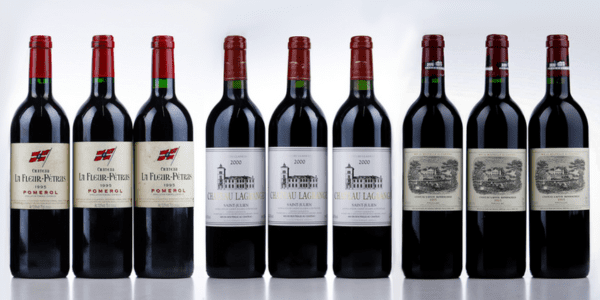
16. Ch. La Fleur-Petrus,
17. Ch. Clos Fourtet,
18. Ch. Rauzan-Ségla,
19. Ch. Brane-Cantenac,
20. Ch. Le Gay
Please see our list for what we can offer – a selection of the most promising and least risky out of these 20.
Categories: Investment • China • Bordeaux
31 October 2011Is this the right moment to buy Bordeaux?

by Mark Schuringa
One swallow doesn’t make a summer but there are a few signs that Bordeaux prices might soon turn around:
- Two weeks ago, the Liv-ex 50 was up for first the time since late June (although last week saw a small drop again).
- Lafite 2008 and Mouton 2008 have been rising, as some traders seem to think prices have dropped too far.
- Well priced offers are still there, but drying up.
- More and more people think the bottom of the market is not far off, so demand is increasing – including 1st growths.
- Europe has taken what could be a decisive step.
- The majority of En Primeur payments will be done at the end of November, meaning that, for some traders, there will soon be less need to sell.
- Reportedly, there are at least 2 wine funds in China that will become operational at the end of the year.
- Chinese New Year is coming up, traditionally the single most important purchasing event of the year.
In the meantime, everybody’s off to Hong Kong this week for the HK International Wine & Spirits Fair, as well as Wine Future HK.
We will be there as well. It will be a good opportunity to assess first hand what the state of affairs is in HK and China. It's a fact that demand from China is a far cry from what it was last year, due to stockpiling by traders. Only when this stock is finding its way to the end-consumer, will Asian demand restore itself again. We'll try and find out and, as always, we'd be very happy to discuss our views.
Categories: Investment • China • Bordeaux
28 September 2011Why Bordeaux Fine Wine prices are falling

by Mark Schuringa
There’s always loads of noise and comments on blogs, websites and Twitter when Fine Wine prices are going up, often amounting to plugging one’s own business. As of the last month or 2 though, I have not seen many comments on the current state of affairs in the fine wine market, whilst there’s more need for that than ever. So we thought to have a stab at explaining the market and provide readers with some transparant, meaningful information.
Being on the forefront of the fine wine trade, we have a pretty good understanding of market forces. In our team, there’s thorough understanding of not just fine wine, but of luxury markets, of macro-economics and of financial markets. So we’d be pretty well positioned to make coffee out of all what’s happening in the fine wine trade. However, we don’t have a crystal ball so don’t sue us if we get this wrong. And like Keynes said, “in the long run we’re all dead”.
Facts
At the moment, prices of Bordeaux investment wines are coming down. From the top, late in June, to now, the benchmark Liv-ex 100 has fallen 13%. There is demand, for sure, but buyers need a discount. The market has transformed from an extreme sellers market into a buyer’s market.
Looking wider than the Fine Wine market, the broader financial markets are in turmoil and have fallen as a consequence. Uncertainty, fear even, seems to rule. No less than £75 billion was taken out of the equity markets since April, more than in the same amount of months post Lehman in 2008. As long as the possibility of Euro members defaulting, and all ensuing consequences to global economic growth, loom large, investors struggle to get their valuations right. Not to mention the risk of major, developed economies falling back into recession. In comparison, fine wine is doing relatively well.
Forecast
The million-dollar question is, of course, where this will all lead. Rephrase, where this will all lead to in the short term, because in the longer run, the fundamentals for fine wine investment are still in place. It takes more than temporary oversupply, or even a massive new market like China, to structurally dislodge the fundamentals of top fine wine. There simply is not enough supply for demand. At the moment though, there are some conflicting forces at work. Right now, the “bear/against” camp is winning the battle, but our belief is that the “bulls/for” side will win the war. Please see below for our thinking behind that.
Fine wines prices will slide further
The bear camp would say that Fine wine prices have gone up way past their historical average. Therefore, a correction is long overdue. In fact, 13% is not much of a correction. In comparison, in the autumn of 2008, the market came down by 25%, after which the index increased by 80%. We will need to see another 10-15% at least before we get back onto a sustainable path.
Furthermore, they'd argue, a major driving force of the last 3 years or so has been Chinese demand. Whilst we all thought that every single bottle sold to China was immediately necked for lunch, it now becomes apparent that this is not the case. It’s not all being consumed, "they" do not drink it all. Although a disproportionate amount of expensive wine does get consumed. At the moment, Chinese traders hold too much stock, bought when prices were going up, with the aim of selling it at a later stage. This “clog” needs to clear the pipeline before prices can move up again.
But, the bears argue, that might take a long time as the Chinese consumer is not prepared to pay ever increasing prices for Bordeaux, particularly now that they are getting more interested in other regions that make equally good wines. This might not hold true for 1st Growths, but it could well have an effect on other Classed Growths.
Finally, due to fine wine now being an investment vehicle, the market is much more volatile. Swings can be much more severe than we’re used to. When stockholders get nervous, a massive supply can suddenly hit the market and erode confidence.
Fine wines prices will soon start rising again
The bulls see it differently. The fundamentals are unchanged. Supply is still very limited in relation to demand, it's finite and impossible to increase. Luxury markets worldwide are booming. That is a trend forecasted to grow and continue for many years. A blip in confidence, a recession even it if comes to that, will not change that. Demand therefore will be larger than supply and we know what that does to prices.
Furthermore, the Fine Wine market is about 1/15th the size of funds leaving equities in the last 4 months. All that money needs to go somewhere and SWAG’s (silver, wine, art and gold) see a piece of the action. Even if only 1% were to go into wine – £750m – that would be roughly 15% of annual fine wine turnover and more than enough to have large implications on prices and availability. Don’t underestimate the influence of wine investment, it’s massively important, particularly in the UK, the US and, dare I say, in HK.
The relative lack of demand we currently see is temporary, healthy, and largely the result of fear on the financial markets. Once there is a sense that European leaders start sorting out their mess, once more people start calling the bottom, then uncertainty will make way for a sense of perfect timing to get invested. And the bulls think that will have a direct effect on Fine Wine. All we need is an important party to start buying. In fact, judging by today’s activity, that moment might have come.
A word of warning
Message to the Bordeaux chateaux owners: don’t be greedy. Don’t kill the goose with the golden eggs with unsustainable pricing. The 2010 Primeur campaign did not go down very well, not with Le Place, not with merchants and certainly not with consumers. These are the people that pay your bills, so please, make sure the next En primeur campaign will see much lower prices. If it doesn't, you risk damaging the whole concept of buying En Primeur.
Another, potentially even bigger danger is counterfeit. This is a real problem in China and has the potential to destroy any faith investors have in provenance. As long as we can’t be 100% sure that stock coming from Asia is genuine and has been properly stored at every point in the supply chain –something which is not currently the case – it should not be touched. In fact, assuring provenance should be given more attention as it is, even without the counterfeit issue. Encouragingly, there are more and more initiatives being taken to improve on that, which ultimately will be an enabler for Fine Wine to become a widely accepted alternative investment.
Concluding, there is a lot of uncertainty at the moment and nobody really knows what the outcome will be. Whilst above is only a snapshot of all arguments you can bring to the fore, both for and against, we believe there are strong enough reasons to conclude that the Fine Wine market is fundamentally in good shape and will soon see prices go up again. We have not quite reached the bottom, but we’re not far off. So, the coming few weeks might just present an exceptional buying opportunity for the brave.
We'd very much welcome your take on this. Let us know if you agree/disagree. Please posts your comments on our Facebook page. Go on, join the debate!
Categories: Investment • China • Bordeaux
7 September 2011Fine Wine Market update and outlook

by Mark Schuringa
Now that what seems to have been a very long summer break is over, it’s time to catch up.
The Fine Wine Market
Immediately after the En Primeur campaign finished early July (!), activity dropped right off. July still saw relatively brisk trade, but August was very slow, slower than recent years. Partly due to the trade having had quite enough of the long drawn Bordeaux En Primeur season, partly because of the holiday season, but mostly because of the uncertainty on the financial markets, coming right in the holiday season. There was not much demand and, as some stock holders preferred cash over paper profits, there was a steady stream of supply. As a consequence, prices dropped (more on this to follow). Particularly because First Growths led the way, and because we haven’t seen any monthly price drops for quite some time now, questions were being asked as to whether this could be the correction that has been predicted by many. The high prices of 2010 Bordeaux seemed to further fuel this thought, not unlike boom before bust. Speaking of the 2010 vintage:
The 2010 Bordeaux En Primeur campaign
Was long. Very long. High quality wines, high prices, big ego’s, long waits. We have covered this subject quite a bit on the blog, so for details please check the blog archive. Our opinion is that it was a very badly managed campaign, with basically all players in this market bar the Chateaux feeling hung over, the consequences of which we might well feel in the years to come. Ultimately, the concept of selling future wines needs to work for all parties involved, something which was not the case in the 2010 campaign. A shame really, because quality wise this vintage deserved much better.
What is interesting to cover is whether the 2010 campaign was successful in terms of sales. The answer depends on who you ask. The Chateaux had a bumper year, no doubt. I believe the French Negociants did do ok, although they were faced with a high risk of being left with very expensive stock. Remember, the Negociants pretty much have to take their historical allocation off the Chateaux, so they bear the risk, not the Chateaux. They sold through relatively well, although remaining stock must be higher than in 2009.
Because, overall, consumers were not nearly as excited about 2010 as they were about 2009, it was the “secondary” trade (merchants around the world) that was left holding much more stock than wanted. Or, if not, at the price of reduced future allocations. The consensus seems to be that 2010 sold about 40% of 2009 (which admittedly was an incredibly successful year). Importantly, sales were at a historically very low margin. There was lots of discounting going on, anything to sell the allocations one wanted to keep.
Up until the last 2 weeks of the campaign (until Vinexpo), Ditton Wine Traders were actually up on 2009, by a whopping 60%. Early on in the campaign, there were great wines to be had, at decent prices, something we did much more successfully than in 2009. Over the whole campaign, we sold 20% more different wines than in 2009. The last 2 weeks, when the 1st Growths and most super seconds were released, were not as successful as 2009 though, resulting in the end in a turnover of 78% as compared to 2009. When compared to most other UK merchants, we did extremely well. Although I don’t think this justifies being occupied with En Primeur Bordeaux for 2 months… Something to think about for 2011.
Fine wine prices
Starting in July and accelerating in August, most prices have come down. As measured by the Liv-ex 100 index, prices have decreased by about 6% in July and August. First growths, as measured by the Liv-ex Investables index, have done slightly worse, printing a fall of 7%. This was mainly caused by Lafite (see Liv-ex article), another major contributor being Parker’s downgrading of 2008.
What has caused this drop in prices? In our humble opinion, 3 main reasons.
Firstly, it seemed a natural moment for people to cash in on the profits they made over the last years. Well before the Primeur campaign, there was already lots of talk about price rises being unsustainable. It’s quite natural that people want to cash in on very handsome profits as they sense that the market might have reached a peak. Consequently, a lot of stock came onto the market.
Secondly, this boost in supply coincided with the holiday season and, importantly, the fact that the international fine wine trade was still holding a lot of stock, bought at cheaper prices. In particular the Chinese traders – we believe – held a lot of stock, bought when prices were going up ferociously. Note though this weak demand does not necessarily have anything to do with demand of the final customer (be it drinkers or investors).
Finally, the timing coincided with a general feeling of uncertainty, generated by another looming recession, continued systemic problems in the EU and resulting, massive falls on the financial markets.
Fine wine as alternative investment
First of all, we have to see this price drop in perspective. During the same period (July-August), the FTSE has lost 10% of its value, the German DAX even 17%. The financial markets have seen turmoil reminiscent of post Lehmann in 2008, with some very fundamental issues that have so far proven to be impossible to solve adequately. Given that Fine Wine is now, to a significant extent, an investment vehicle, it’s actually a remarkable resilient performance. From first hand experience, it’s clear that a lot of money is being swapped out of bonds and shares, into alternative investments like Fine Wine.
Secondly, no market can keep going up. If it would, there would be the mother of all corrections at some point. It is actually very healthy that prices have come off a bit. It allows for a period of consolidation, reflection and normalization. Which ultimately avoids boom/bust scenario’s.
As for demand of the final customer, September sees more activity again. UK investors are once again keen to invest in wine. Our customers in Asia are definitely back to buying, albeit more selectively than early in the year. We don’t see any indication that there could be a fundamental shift in the total level of demand, which – if true – will keep in force the age old adagium that demand outstrips supply.
Movers
Stock picking is very important and even more so now that there's a distinct gap in performance between several "classes" of wine. At the moment, there is a trend towards super seconds and "flying fifths" as well as cheaper Grand Cru Classees. It’s no longer anything 1st Growth and their 2nd wines.
As predicted on our blog a few months ago, customers are more aware of value for money. Although, at the same time, the truly iconic wines and vintages keep on doing well (as always).
At the same time, investment money is still flowing in. Wine investment funds and, to a slightly lesser extent, investment brokers make sure their portfolio’s are constituted of at least 50% 1st Growths, in some cases even 100%. These companies need to buy stock, there’s only limited supply, so we expect the current fall in 1st Growth prices to be reversed in the very near future.
On a final note, we do see growing demand from Asia for super Italians, as well as for Burgundy and indeed some New World regions. As this fabulous part of the world gets more acquainted with fine wine, and as prices of their first choice (often most iconic) wines go up and up, it’s natural and healthy that the eye is being cast on other wine regions that make great wine.
Our Picks
Not everything has come down in price. Some wines are actually up (Lynch Bages, Cos Estournel, Montrose, Pontet Canet). La Mission Haut Brion has had an incredible run. There's a lot of coverage on the performance of the "super seconds" and "flying fifths" as well as some of the cheaper GCC. The common factor with these wines and the reason behind their succes is that they are all well known brands, that they have made stunning wines in 2009 and 2010 as well as in some older vintages, and that their prices do not (yet) reflect the quality. We'd be very happy to advise on them, so if that strikes a cord, do get in touch.
Worth an extra mention is that Robert Parker has recently conducted an extensive vertical tasting of Lynch Bages, spanning 1981 – 2010, re-rating the wines accordingly. The market has already reacted, but it's likely that some vintages of what's arguably the strongest brand behind the 1st Growths will continue to do very well. We will cover this in our next blog post.

Finallly, something else to take notice of, is the "Magical 20" as selected by, again, Robert Parker. On November 8, he will conduct a tasting of "estates that produce wines of "first growth quality" although technically not first growths...and because of that are under-valued and very smart acquisitions". This might well have some effect on prices. Here's his list:
1. Ch. Cos D'Estournel,
2. Ch. Pontet Canet,
3. Ch. Pichon Lalande,
4. Ch. Leoville Poyferre,
5. Ch. Leoville Las Cases,
6. Ch. Palmer,
7. Ch. Malescot St.Exupéry,
8. Ch. Pape Clement,
9. Ch. Haut Bailly,
10. Ch. Angelus,
11. Ch. Trotanoy,
12. Ch. La Conseillante,
13. Ch. Pichon Baron,
14. Ch. Lynch-Bages,
15. Ch. Smith Haut Lafitte,
16. Ch. La Fleur-Petrus,
17. Ch. Clos Fourtet,
18. Ch. Rauzan-Ségla,
19. Ch. Brane-Cantenac,
20. Ch. Le Gay
So, enough reason to expect this trend for value to continue. Go for well known, non 1st Growth names with high scores. And don’t forget to stock up on 1st Growths before they go back up again.
Categories: Investment • China • Bordeaux • En primeur
6 September 2011Aussino continues to work with Bordeaux

by Mark Schuringa
Aussino clarifies Bordeaux position.
In July this year we published an article commentating on a report at decanter.com that Aussino, a major mainland China retailer, had determined to stop working with the Medoc classed growths, apparently due to over-heated prices. Aussino has since published a statement on its website to the effect of disqualifying the reported position, leaving no doubts as to the retailers continued support for top Bordeaux.
Dear all,
The recent article in decanter.com was a result of misunderstanding between the Decanter journalist and Grace Cai during their conversation. Aussino management announce that we are not changing policy to work & promote Bordeaux wines.
As the pioneer of wine culture promotion and education in China, Aussino has devoted itself to the long term partnership with many Bordeaux Grand Cru Classé Chateaux, which has been widely known and well appreciated. Also Aussino works with numerous Bordeaux GCC wineries as important business partner in China market as long term strategy.
We have published and republished the Aussino Wine Stories since 2000. The sixth edition is set to release in September 2011. The book, one of the most popular and best-selling wine books in China after 10 years of marketing cultivation by Aussino, introduces the stories of famous wineries worldwide including numerous Bordeaux Grand Cru Classés for the Chinese reader.
On the other hand, Aussino has also organized a great numbers of Grand Cru Classés dinners in mainland China since 2000. Aussino Wine Life, one of the most influential wine industry magazines, reports on every Grand Cru wine dinners. More than 50 Grand Cru wine dinners will be organized in different cities in the second half of 2011.
Aussino will keep on devoting tremendous effort and investment to cultivate the wine market in China. We will continue to work with our quality suppliers worldwide and of course including our partners of Bordeaux to introduce wines with high quality and good value to the Chinese consumers.
Best Regards,
Aussino World Wines
19th July 2011

Categories: Investment • China • Bordeaux
5 September 2011The 2010 primeur campaign and China

by Mark Schuringa
We found this interesting article on Wine Spectator: "Did China really save Bordeaux?" It gives some further insight into the success or lack thereof of the 2010 Bordeaux En Primeur campaign, and the role of Chinese /HK buyers:
Throughout this summer's sales campaign for 2010 Bordeaux futures, as châteaus released their wines at record prices and a number of loyal customers in America decided to pass, most analysts believed China would make up the difference. Thirst for high-end Bordeaux among China's wealthy has been growing for five years. This was supposed to be the year China came through for Bordeaux, leading to one of the most lucrative futures campaigns ever. If only it were that simple.
“We had a really good campaign,” said Jean-Pierre Rousseau, managing director of the négociant Diva. "We did as well as last year [value-wise]. But overall, we sold much less wine—fewer brands and less volume of each brand. And we also kept less wine than last year."
Several sources told Wine Spectator that yes, this was the most profitable futures campaign ever and China deserves a large amount of the credit. But the campaign was not the blockbuster many had hoped it would be.
Bordeaux’s top producers released the 2010 vintage at record prices, but the châteaus’ pricing strategy backfired in several ways. Merchants said that while some top names sold easily, other past bestsellers were not in demand. To move the wines, négociants would only give clients the top wines if they also took the others. Clients refused to hold onto “grossly overpriced” wine, and there was widespread discounting to quickly move the “toxic” brands out the door.
As for China, many châteaus priced themselves out of America and Europe and failed to attract the Chinese. “It would be wrong to say that Chinese customers have jumped at buying everything. That is not true,” said négociant Philippe Laqueche, general manager of Yvon Mau, whose 2010 campaign profits topped the 2009 campaign. “I think the campaign showed the strength of brands.” Pontet-Canet, Pichon-Baron, Beychevelle and Grand-Puy-Lacoste flew out the door. Smith-Haut-Lafitte, Rauzan-Ségla and Figeac, not so much, according to leading merchants in London and Hong Kong.
According to one broker’s report, 365 wines were released as futures during the 2010 campaign, with 89 percent of the allocated cases finding buyers. That’s the same clearance rate as the 2009 campaign, but fewer wines—403 wines sold during ‘09—and a far cry from the 93 percent clearance rate on 436 wines sold during the 2005 campaign.
Some merchants did well. ASC Greater China, a leading fine wine importer with 23 offices in China, increased its purchases but still only took a fraction of the offer. “We bought about 70 labels, of which 30 to 40 were for China and the rest were for Hong Kong,” said Don St. Pierre, Jr., CEO of ASC. “In total we purchased 90 percent more by value than we did last year and our total quantity was up by at least 70 percent. We took all the normal allocations and tried to get more allocations for the key wines that have demand and recognition in China.”
Demand for those key wines is fierce, and prices aren’t likely to come down unless the Chinese suddenly stop giving wine to business partners and high-ranking government officials. “The wine used for these purposes has to be famous and well-known in China [such as Lafite Rothschild]. Otherwise the gift giver or host may lose face,” explained Hong Kong businessman George Tong, whose own 2010 shopping list included the first-growths, second-growths, Le Pin and Pétrus. “If someone presents a bottle of Penfolds Grange or Harlan Estate as a gift or hosts a dinner serving them, he will lose face. They are very fine wines, but few people in China know them.”
But ongoing Chinese demand for other wines is less certain, particularly since China's nouveau riche were forced to take wines they didn’t particularly want in order to get their hands on the Lafite and other must-have gift items.
Nor did Chinese companies appreciate the disorganized tempo of the campaign—snail-paced at first, then frantic at the end, with 35 estates releasing in a single day. Pricing and tempo left private investors, a growing segment in China, disenchanted. “If prices drop later, everybody will be upset,” said Bandy Choi, a Macau and Hong Kong retailer who provides wine investment training to Bank of China executives.
Speculators are also muddying the waters. “We see quite a few wines that are not selling so well yet in China, but because of demand in Hong Kong the perception is they are very popular in China,” said St. Pierre. “We think most of the speculation is coming from brokers in Hong Kong and the U.K., betting on the next big thing. But since none of these companies have much of a presence in China, they are really very far away from reality.”
Aside from the seasoned importers with strong distribution networks like ASC and Aussino, most of the Chinese buyers, many of whom are large corporations who would just as happily import scrap leather, are worried about the next step: turning a profit. “They bought in '09 and haven’t seen any profit and now with 2010 they question if they will see profit again, so they are right to be cautious,” said Doug Rumsam, managing director of Bordeaux Index (HK). “Time will tell as to how these corporations offload these wines and the success of their long-term strategy.”
At its essence, the futures game is one of opportunism, nowhere more so than China. “If the Chinese cannot make big money in the primeur business, they will quit,” said Laqueche. That is particularly worrisome, because a large amount of Bordeaux’s grand cru classé now goes to China and Hong Kong. “The new concern over the long term is the geopolitical balance of wine,” said Laqueche. “Shifting from loyal customers to new customers—that’s an upside-down way of thinking. Perhaps it’s a historic move but it’s a dangerous one. We need to maintain traditional markets.”
Some négociants hope that Americans will begin buying petit châteaus priced between $15 to $35. But those wines aren't well-known in the U.S. “There really is not much of a petit [château] market,” said James Gunter, senior vice president at Glazer's, a major U.S. distributor. “Négociants want to sell them, but do nothing to promote them or help sell them and build in the marketplace. Estate owners really don’t get marketing and promotion in the U.S.”
Which means Bordeaux may be putting all its eggs in China's basket before it truly knows—or understands—the Chinese market.
Unquote. Now that the holiday season is finally over, we will shortly give our take on the campaign as well as the current market. Watch this space.
Categories: Investment • China • Bordeaux • En primeur
18 July 2011Aussino to stop buying Left Bank Bordeaux

by James Swann
Decanter magazine has published an article examining the decision by Aussino Cellars, a leading retailer in mainland China that maintains 200 wine stores in 100 cities, to abruptly cancel its annual meeting with the Union de Grands Crus while stating that it intends to stop buying Left Bank and instead will invest in the Right Bank Bordeaux.
Sylvie Cazes, managing director of Pichon Lalande and re-elected the union’s president earlier this year, has responded with calm “We are sorry to hear Aussino doesn’t want to organise the tasting with us this year, but we are committed to China, make at least two trips a year there and would be happy to work with Aussino in the future”. Earlier this month Ms. Cazes published a similarly composed view at Decanter.com on the enduing question of a bubble in the Bordeaux market: “‘Every time there is a new market, tension is created. It happened with America in the 1980s and it happened with Asia…I don’t believe in bubbles – with a bubble you have a great increase, then it bursts. I don’t think this will happen – the market will stabilize itself, and with 2010 we are seeing the start of that regulation.’
For his part, Aussino owner, Robert Shen – listed at no. 17 in the Decanter Power List 2011 (up from 28 in 2010) – considers prices at the top Medoc estates ‘too dangerous”. Grace Cai, Wine Education & Culture Manager at Aussino World Wines, elaborates “The prices of the Grand Cru wines are too high because of the booming wine market in China, and it is very dangerous to keep on promoting them. ‘As our consumers become more and more educated about wine, they will realise that they are buying over-heated brands, and we want to offer them wines with stability”
To this end Aussino has apparently entered into business with high-profile Pomerol growers, J.P. Moueix and Jacques Thienpont of their respective estates, Petrus and Le Pin, with immediate effect. Their stated aim, alongside known brands, to develop own brands for the China market.
More than price
Independent of such reciprocal statements, it is clear that the abrupt departure of such a high profile distribution partner marks a very real statement. This, far from being an isolated case, is in fact, supported by a number of broader indications as to the possible direction of the Chinese market overall. The first and most obvious is the possibility of other Chinese merchants adopting the explicit aims of Aussino, through winding down inventories of those wines in the eye of the price storm, whilst simultaneously taking control of production of wines for which it clearly sees or anticipates demand. Recent history shows there are already precedents here.
The most notable example is to be seen in the widely reported February 2011 acquisition of Lalande-de-Pomerol estate, Chateau de Viaud, by COFCO, an argi-business conglomerate supported by the Chinese government. Its stated aim ”… a strategy for constructing a complete chain from production to consumption to guard against forgeries and to reassure our clients” – guarding against forgeries was also specifically highlighted by Ms. Cai during her discourse on the matter.
The market
How should one interpret this?
Well, as ever, there is a short-term and long-term view. Looking at the short term, we are seeing the kind of price spike that comes with expansion in demand. This occurred when the US market first opened up in the 1950s, followed by its use of futures in the early 1970s (yes, they did pioneer it before the British took it up as en primeur a few years later) and, the consolidation of the US as a major player from the 1982 vintage on. The immediate effect of which, as early as the ‘ 50s, was the appreciation of prices for First Growths by 50%. Buyers began to look for value, the same will happen now.
As far as it goes, then, the Aussino move could be seen as a simple sign of the maturing of a new market – one where appetite for Bordeaux has been in evidence for at least 5 years and will continue to be so – that now also becomes interested in other wines outside of the initial 10-15 icon wines. That is a healthy development where the love for Bordeaux goes hand-in-hand with a greater awareness of price and value.
Importantly, to the Chinese-Asian buyer, this value may well appear to also exist in entirely different regions. A certain rise in demand for the sought-after wines of Italy has been in evidence among traders of late. When one considers the enduring and influential popularity of Italian cuisine, it would be expected to continue. You only have to consider that the most investable Italian estates offer 6-packs for sub-£1, 000, as opposed to average 12-pack prices of +£8, 000 for First Growths, to understand their allure.
Nevertheless, with regards to development within Bordeaux itself, it is the longer-term that offers perhaps the most significant and intriguing considerations. The Chinese have yet to embrace en primeur and in other areas have successfully bid to take control of production themselves – Chateau de Viaud is the seventh acquisition by a Chinese proprietor since 2008 and in all cases production was re-directed in its entirety to China.
Perhaps most intriguing of all though, the role of Robert Parker as market maker is increasingly being questioned. We have already seen the emergence of ‘Chinese brands’, and indeed off-vintages thereof (2002, 2006, 2007), outperforming their Parker scores to initiate an apparent, albeit evolving, Asian consensus within the 1855 Classification. Indeed, Parker has recently broken with tradition (in an apparent attempt to affect pricing policy?) stating “I hate to see the image [of Bordeaux being great] damaged by the fact people tend to think it’s too expensive,’ he is quoted as saying. ‘Bordeaux is focused too much on the wealthy Asian market”.
There is, perhaps, more than a passing resemblance between this and the pricing out of the British and other European markets in favour of wealthy Americans in the 1980s. The ball, it would appear, is firmly on the other foot. Today, it is the Chinese businessman who is profiling as the single most important market maker and indicator of future prices.
Selling direct
There is, somewhat descreet, speculation within the trade that a certain degree of direct selling is occurring at top chateaux, nominally wedded to La Place. La Place, the local term for the traditional system of distribution, whereby top wines and lesser-known ones, reach the open market through an historic and exclusive chain of chateaux, courtiers au vin (grape brokers) and négociants (wine merchants and brokers). An opaque system and one open to price manipulation through the holding back of wine in function of demand and policy, therefore providing an entirely notional indicator of supply. Until very recently, the prevailing wisdom was that small chateaux with strong brand awareness (and alternative distribution channels) may not need it – witness Chateau de Viaud – but the top Medoc estates certainly do. One only has to consider that such chateaux typically have between 15, – 20,000 cases to sell in any given vintage; no other system is capable of moving that much high-priced wine in a matter of hours. Whereas direct sales by sought-after chateaux will likely remain an area of speculation for some time yet, another form of direct distribution may well be just around the corner. The acquisition of Chateau de Viaud has apparently more than just value at its heart. As a proprietor, chateaux owners are in fact entitled to and able to access significant volumes of wine, something that chateaux have largely left to the négociants.
In his signing ceremony speech, Chi Jingtao, Vice chairman of COFCO, stated the company’s intention to distribute classed growth, in this case through S.A.S. Majorlaine, a négociant house owned by Philippe Raoux, the previous owner of de Viaud. Majorlaine, est. 1920, has to date, specialised in supplying branded wines from petit chateaux to private clients in France, only exporting around 5% of its production. COFCO, in partnership with the négociant, now wishes to further use develop a new wine brand for the China market.
Historically, the emergence of new markets entailed, what in fact amounted to the deepening of traditional practice; the control of supply and demand by La Place together with significant influence by, typically London-based, British merchants. The latter having built up a privileged position based on important allocations through, quite literally, centuries of trade and promotion of Bordeaux wines. Indeed, most Hong Kong merchants are today branches of those same London merchants. The Chinese, so courted by both La Place and London merchants, may have determined that, as the most important consumer market, they are going to have a say in this.
Categories: Investment • China • Bordeaux
1 June 2011Latour chases Lafite in Hong Kong auction scene

by James Swann
Eyebrows rose yet again at further new records set for fine wine prices of Bordeaux first growths led by the Hong Kong offices of the major fine wine auction houses.
In a clear bid to position itself in-line with its Pauillac neighbour, whose significant price lead in the fine wine market over its Bordeaux peers was given a boost at a Sotheby’s wine auction on the island earlier this year, Chateau Latour chose Christie’s auction house to conduct last week’s ex-cellar sale. Of course, the owner of Latour also owns Christie’s.
As with Lafite, Latour’s wines came straight from its own cellars in Bordeaux, the so-referred to provenance that has become central to wine investment and in recent years as a mark of authenticity, scarcity and guarantee of storage conditions.
392 lots came under the hammer in an 8-hour session that saw total sales reach a staggering £4.6m ($7.6m) with prices more than doubling their pre-sale estimate for some wines. Asian buyers again accounted for the lion’s share of successful bids in an auction noted for its large format bottles - something that to date has been slower to be in embraced in Asia. . Only 2 cases of 75cl bottles in the whole sale.
The top 3 lots were identical 6-magnum lots of 1961 fetched well over double the high estimate of some £66,000 or HK$850,000. A single 1961 imperial (6L.) weighed in at £131,544. Other historic vintages, such as the 1945, saw a 75cl. case go for £122,148 after an initial estimate of £56,000.
Latour, the exception that proves the rule?
With regards to formation of fine wine prices and the Asian buyer threshold, although the average Westerner may well ask is there one, Latour has leveraged off a range of factors. Its choice of Christie’s to hold the auction as an apparent head-to-head following Lafite’s earlier success may be one. Another is that Lafite prices would have appeared to have plateaued and are in fact coming slightly off the boil. However, average prices for its first growth peers remain well behind, meaning rising first growth brands are still within Asian buyers comfort zones.
More than any other factor, however, is provenance, the new mantra of the fine wine collector, drinker and investor. Not only did these wines come straight from Latour's own cellars but Frédéric Engerer, the château director and President, personally inspected each and every one of the bottles before approving them for consignment. More importantly, Engerer then went on to apply a ProoftagTM to every bottle, a unique tracing system that can be used to prove the bottle has been released in April 2011 direct from the Latour cellar. To which he engraved the words ‘This bottle was released directly from the cellar Chateau Latour in April 2011 specifically for Christie’s auction in Hong Kong on May 27th 2011.
Nonetheless, large formats and special releases aside, as far as the wider market is concerned one of the most notable features of the auction is that Latour’s younger vintage releases – 2000, 2005, 2009 – saw hammer prices that came in marginally lower than their current prices on the open market, in a clear sign of Asian buyers growing awareness and a resistance to over pay. Buyers are not fools!
We have reviewed wine auction prices vs. open market prices in earlier blog pieces, with buyer’s premiums and other factors taken into account, it has been widely commentated that the results show auction buyers pay a premium over London market fine wine prices. It is highly likely that whereas such auctions may continue to be the preserve of some first growths, overall the open market remains the most competitive place to buy, or sell.
Categories: Investment • China • Bordeaux
14 February 2011Savvy Chinese buyers looking beyond Bordeaux
Decanter published below article on their website today. From our own sales, we can confirm there is clearly a widening demand for Bordeaux. Top sellers for us have been Ducru Beaucaillou, Lynch Bages, Pontet Canet, Beychevelle, Cantemerle, La Mission Haut Brion, Leoville Lascases and Pichon Lalande to name a few. We also think that it's a matter of time before demand for Burgundy will increase even further, as well as for Barolo and Tuscany's top producers. This is a logical consequence of both drinkers and investors looking for value for money and is a healthy development.
Savvy' Chinese buyers looking beyond Bordeaux
- Monday 14 February 2011
- Be the first to comment
Chinese fine wine consumers are diversifying beyond Bordeaux and buying an ever wider range of wines from Burgundy and the New World, local merchants say.
Berry Bros & Rudd Hong Kong managing director Nick Pegna said the company’s sales of Burgundy had trebled during the campaign for the 2009 vintage in the run-up to the Chinese New Year. And Don St Pierre Jr, CEO of ASC Fine Wines, added that demand was rising for top wines from other regions, including Penfolds Grange, Phelps Insignia, Shafer Hillside Select and Gaja Barbaresco. ‘The range of Burgundies was broad and excluded a number of blue chips which aren’t released at this stage, namely DRC, as well as Clos du Tart,’ Pegna told Decanter.com. ‘This was the likes of Comte Armand, Fichet, Gagnard, D Lafon, de Montille, Grivot, Clavelier, Rion, Rossignol-Trapet, Vougeraie.’
Pegna emphasised that Bordeaux continued to dominate fine wine sales, adding that sales of Mouton-Rothschild, Margaux and Haut-Brion had improved in the last two months. ‘Also, we have had some strong interest in older vintages of the likes of Cos d’Estournel, Pontet-Canet, Grand Puy Lacoste, Figeac and Lynch-Bages. ‘In general terms, the market is becoming less polarised around a few names and buyers are diversifying, even for gift-giving which dominates this time of year.’
St Pierre said business was still good, with ASC sales for January and February likely to be about 35% up on last year, but added that demand for Bordeaux had shifted from the top five or seven wines to a broader selection of 15-20 chateaux.
Edward Ragg of Dragon Phoenix Fine Wine Consulting added: ‘More savvy buyers are looking at securing value from classed growths that are less well-known.’ He continued: ‘Wine lovers who are looking for something new and are keen to learn are gravitating towards the likes of Burgundy and the Rhone. ‘This is especially true among affluent, younger consumers who tend not to be as biased toward France and express interest in high-quality wines from various countries.’
Categories: Investment • China • Bordeaux
8 February 2011Burgundy: start hoarding
The Wall street Journal posted this article on their website today:
Acker Merrall & Condit Bottles of 1985 Henri Jayer Richebourg: Is 2011 Burgundy’s breakout year in Asia?
After Bordeaux wines fetched sky-high auction prices last year in Hong Kong, it seemed like France’s other top region — Burgundy — was getting neglected. But this year might be Burgundy’s time to shine.
Early reviews of the 2009 vintage of Burgundy are in — critics began tasting late last year — and the verdict is good: According to the London-based dealer Bordeaux Index, the 2009 vintage is “the most forward and generous one over the past decade.” And the WSJ’s London-based wine writer Will Lyons was giving the vintage high praise in a recent column:
Burgundy still makes up less than one-tenth of overall wine sales in Asia, Mr. Pegna said. Still, the hype around the 2009 Burgundy highlights a greater fear — or optimism, depending on who’s talking — of a massive influx of Chinese buyers picking up the top Burgundy bottles of all vintages.
Click here for the full article in WSJ.
You may have noticed that we hardly sell any Burgundy. We are in the process though of building up our network and list. If we can offer at the same competitive prices you are accustomed to from us, and if we can source the most sought after wines, we will be offering them to you. Watch this space!
Categories: Investment • China • Burgundy
13 January 2011Fine wine prices, bubble and currencies
The latest monthly bulletin from Liv-ex, shows the effects of currency exchange on the strong price appreciation among the London trade, suggesting there may yet be some way to go amid increasing concerns about a fine wine bubble. Supporting this interpretation are the results of their benchmark Liv-ex Fine Wine 100 Index, which the exchange has converted into other major international denominations, including Gold.
The Liv-ex Fine Wine 100 Index is widely taken to be the industry benchmark and tracks a trade-weighted basket of the 100 most sought-after wines with a ready secondary market. The index includes wines from Burgundy, the Rhone, Champagne and Italy, but, unsurprisingly, Bordeaux is by far the dominant composite, in December accounting for 96% of total exchange turnover.
Report highlights note that trading activity doubled in 2010, whilst prices as measured by the Liv-ex Fine Wine 100 Index are up 41% in just one year. The 2008 vintage saw the most spectacular increase, doubling the gains of its nearest rival, the previously unsung 2007, with overall gains since the initial release of the vintage even more impressive.
Currency effects. Against such a background, fears of a bubble – in particular among the Bordeaux top 8 – are understandable. Nonetheless, when converted into other hard currencies the Sterling-based index shows a markedly different pattern. Liv-ex figures show that when converted into Euros, prices only surpassed their July 2007 high in the last quarter of 2010. Denominated in US Dollars, the index remains (just) off its June 2008 peak. This differential is most visible when converted into Yen, the index being a whopping 29.7% below its historic high. What then of China? Firstly, when converted to Renminbi, the index comes in at 10% below its all-time high, thus, for the Chinese buyer, wine still remains within a familiar price zone. The country, the major driver for global demand, probably accounted for up to half of the index appreciation for 2010 (Source: The Wine Investment Fund, the drinks business 13-01-11).
Again Liv-ex, brought this piece of news today: “While recent press articles seem to have concentrated on the fine wine bubble story (with Lafite in particular focus), the IMF has published a very interesting piece comparing the fine wine and oil markets. Its conclusion? There is a 90% correlation between fine wine and oil and an increasingly close correlation of both of these "asset classes" to emerging market GDP growth. Yesterday we published our January Market Report- in it you will find some rather interesting charts depicting the Liv-ex Fine Wine 100 Index in base currencies other than Sterling. The market has only just retraced its 2007 highs in Euro terms and remains under water in Renmimbi (below), Yen and gold terms. Bubble?”
One could be forgiven to think that, for all buyers that don’t pay in sterling, prices have not gone as mad as it would seem.
Categories: Investment • China • Bordeaux


English
中文 (葡萄酒和博客用英語)
日本語 (ワイン在庫表&ブログ)